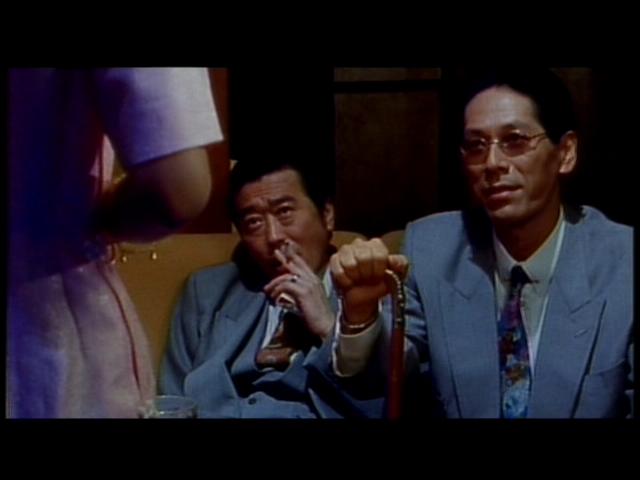
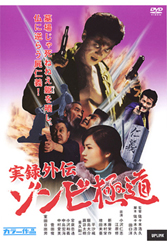
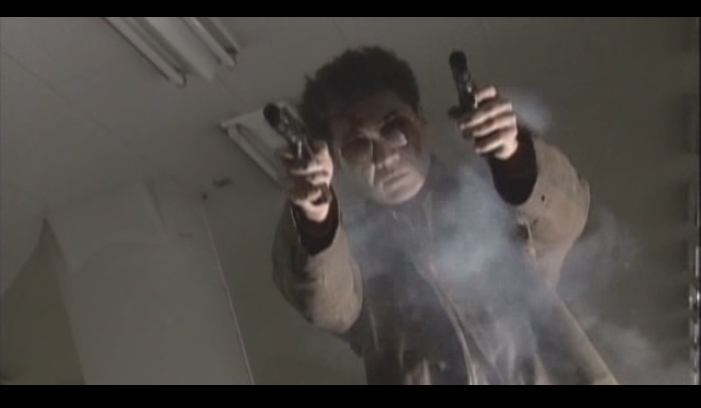
Takeuchi Riki, the undisputed world heavyweight champion of V-Cinema stars in the four-part epic (well, not really epic - it's no Dune) Tokyo Mafia. The first movie in the four part series is Tokyo Mafia: Yakuza Wars, which tells the tale of an ex-Yakuza member, Yabuki Ginya (played of course by Takeuchi) who builds his own syndicate from the ground up, first just to make a buck, but by the end of the movie, his goals become more lofty: to take over all of Kabukicho in Tokyo! (Cue dramatic music here). Kabukicho, of course being the setting of many a Yakuza film. I haven't been to Kabukicho since 2004, but it would be an understatement to say that it had its share of strange and creepy people lurking about.
The Plot.
Ginya Yabuki is a successful criminal on the fringes of Kabukicho, dealing in whale meat and flash memory chips (apparently hot technology back in '95) with a small group of six comrades (explained later as more of a secret society than an actual Yakuza group). But it wasn't always like this. Yabuki used to be a member of the Yamaryu crime syndicate. However, by cozying up to the boss he earned himself a major beat down from the 2nd in command of the Yamaryu group, Iwagami (Played by Yakuza film veteran Osugi Ren, from Sonatine, Shinjuku Triad Society, and can be seen snorting a 15 foot line of coke in Dead or Alive). After getting his face bashed in and an ashtray to the head, Yabuki turns the tables on the overzealous Iwagami by pulling a gun and shooting him in the leg. He bites off his pinky in a spectacular show of badass atonement for his actions, and resigns from the syndicate, followed by his well meaning but not so bright lackey, Yuki, played by Ozawa Kazuyoshi (That's right, the younger brother of always awesome Ozawa Hitoshi from Yakuza Zombie and Wild Criminal).
Nowadays, Yabuki is content to make his cabbage in deals with the various criminal organizations around Tokyo, including the Chinese mafia (who have a habit of cutting off limbs of people who oppose them), and spreading the cash around the guys in his little group - including some white dude named "Smith" (who doesn't seem to speak any Japanese and never really says anything beyond "OK Boss", but who I also swear I've seen in the same role in other Yakuza films). But, as the money rolls in his small cadre starts to grow, and his old Yakuza connections start to get interested in Yabuki's goings-ons. His old friend Sho Saimon helps broker a deal between Yabuki's group and the Yakuza. But quickly the various Yakuza groups want a bigger piece of the pie, and in the words of Yabuki, "Can 70 men stand against 3,000?"
The Characters.
When Takeuchi Riki is handed a script, he seems to take his slide-rule that extends from "good-natured" to "badass", slides it in one direction or the other, and that's how he plays it - some in the biz would call that "limited range". I prefer "consistent". In this case, the Rik-O-Meter was cranked mostly over to the "good natured" side. Takeuchi was still badass enough to bite off his own pinkie finger, but even that show of badassery pales in comparison to many of his more over the top roles, for example, Dead or Alive or Yakuza Demon. All in all, Takeuchi is just doin' his thing.
Already mentioned above, we have "Yuki" played by Ozawa Kazuyoshi, who is loyal to a fault to Yabuki, but also not the sharpest pencil in the box. At first I actually thought I was looking at a young Ozawa Hitoshi, but a quick check of the DVD case, and then a foray into google introduced me to Kazuyoshi. Either way, he wasn't really given much to work with, so I wasn't able to really rank him as an actor. But after Wild Criminal, I've come to idolize his brother Hitoshi, so I'm still willing to give him a chance.
Also mentioned already was Osugi Ren, who plays Iwagami, the shifty and conniving 2nd in command of the Yamaryu syndicate. Typical of enemy Yakuza bosses in Yakuza films, he has more ambitions than brains, and Osugi plays him with an extra dose of exasperation. Sho Saimon, Yabuki's oldest friend, is played by Imai Masayuki, and really comes off as just a really nice guy - even though he's a Yakuza you don't really sense and ounce of bad in this guy, which (spoiler alert!) actually gets me interested in how the eventual confrontation between Yabuki and Saimon goes down in part 3.
The other characters that round out the cast include Ryoko, Yabuki's younger sister who is supposedly fluent in English, Chinese, and (obviously) Japanese, but in reality her English sucks chilled monkey balls - I guess the Japanese audience wasn't expected to pick up on this (and she apparently doesn't rank enough of an actress to get her name on the DVD case either). We also have Moriwaki, played by Yamamoto Shohei, who is the head of the Teito-kai,which is the organization that controls most of the Yakuza groups, including Iwagami's Yamaryu gang. Moriwaki can best be described as your creepy uncle who was never married, and has a fetish for young men and whale meat. Or, let me put it this way - all of the homoerotic scenes in this movie involve Moriwaki. One strangely NOT homoerotic subtitle did catch my eye though:
The Violent Rundown.
Oh yes, Tokyo Mafia: Yakuza Wars delivers a full plate of B-movie violence, including 5 shootings, 5 dismemberments, including Yabuki's bad-ass finger bite kejime, at least 2 brawls, at least 4 beatings, blunt force trauma, bone snapping, face slashing, and an eyeball rupture or two thrown in for good measure.
The Final Verdict.
Yakuza Wars is so straight-to-video that the DVD transfer looks like it was done from an old VHS tape, and the soundtrack is the typical goofy synthesizer jazz track that I hear a lot from these hardcore B Yakuza movies. But, it is what it is, a total B movie, and Takeuchi Riki fans will be happy with the result. Probably in the context of all four movies (which I haven't seen yet) I'll be able to better judge the film, but on its own, it's not terrible and it is entertaining, but that's assuming you're already a fan of the genre. I can't imagine Tokyo Mafia creating any converts, but if you like this kind of thing, I think you'll be down with me when I say, it ain't terrible. I had to wrestle a bit with where to place it, since it's really no worse or better than Wild Criminal, but that movie has more violence, more hot chicks, and Ozawa Hitoshi, so I'm dropping it down just behind Wild Criminal. Not sure what it says about the movie when the best thing I can say about it is that it's not terrible, but I've said it before and I'll say it again - it is what it is what it is. Enjoy!
Extensive reviews of the best Yakuza films, by the gangsters who brought you the Samurai Archives.
Saturday, April 30, 2011
Saturday, April 23, 2011
Outrage (2010)
After a decade or so break from the Yakuza genre, Kitano "Beat" Takeshi is at last back at it again with Outrage - and with a vengeance. I've never really been a "fan" of Kitano, but also never really not liked any of his movies; I've always been sort of ambivalent, probably brought on by everyone else worshiping him back in the late 90's when he started getting big in the West (My anti-hipster bent, I suppose). Kitano's last Yakuza film, Brother, was great, and Outrage is even better. I fell for it within the first five minutes, and was hooked until the end - granted, I had to watch it three times to sort everything out, but I guess you could say the fact that I was able to sit through it three full times and still be entertained is an impressive feat for any movie.
Outrage has game on many levels - it's a political thriller following the ins and outs of Yakuza politics of revenge and atonement between bosses, brothers, and cohorts (at least Kitano's vision of it). It's also a solid crime drama; as the drama unfolds, the factions take sides, and when the bullets start flying, you can't help but get caught up in who's going to come out on top, and even cheer for Kitano's group of bad guys. It's also a procedural drama - The way CSI shows you the police procedures of solving a crime, Outrage shows you the procedures of gang war within this fictional Yakuza group. Interesting stuff.
I've gotten so used to Takashi Miike's over the top Yakuza films, and the over the top exploitation Yakuza films starring the likes of Takeuchi Riki, that Takeshi's Outrage comes across as a serious and straight drama - no cartoony violence or outrageous characters here. And although I've read here and there opinions that some of the characters suffer from a lack of character development, the acting is more than solid enough to make up for it. Quentin Tarantino's Reservoir Dogs is a more than apt comparison - both movies are an event, not a character study, but even still the characters are as real as any that have hit the silver screen.
Organizational Chart.
This movie is one in which it really helps to know who works for who, and where everyone sits in the hierarchy. Fortunately for you, I put together the following organizational chart:
I would say this chart covers the good guys, but like the movie poster says, 全員悪人 (They're all bad men). On the other side, you have the Murase syndicate, led by Murase played by Ishibashi Renji (Yakuza Demon, Gozu), who is trying to associate himself with the Sanoukai. The movie follows the antagonizing, retribution, plotting, and revenge that wreaks havoc from the bottom up between these two groups, and when it's all over, you're left wondering if it was a series of random events or a very specific and complex plot that is everyone's undoing. There are good arguments for either side, but I leave it up to the viewer to make that decision when the credits roll. Giving any more details about the plot would be doing you the viewer a disservice (which is why I'm skipping my standard Rundown format of giving a detailed plot outline), there is a lot going on and a lot to follow, but the journey is worth it, and there is a lot of mental popcorn to chew over once it's over. Which is why I recommend a second viewing.
Cast and Characters.
As for the characters, there are some really stand-out performances (vis a vis the Yakuza genre - this isn't Shakespeare, even if it tends toward the Shakespearean). Shiina Kippei gets mad props as the badass VP of the Otomo Syndicate, Mizuno. After an uninspired portrayal of John Rain in the movie adaptation of Barry Eisler's book Rainfall, I really didn't expect much, but fortunately he blew away my doubts. Shiina's Mizuno is dark, violent, and brutal, but not without a dark sense of humor, with a likable personality. As a side note, I had thought that this type of character didn't exist in American cinema, and normally, it doesn't. However after seeing Public Enemies starring Johnny Depp as John Dillinger, I've finally found an American movie that mirrors the characters in Japanese Yakuza films. Dillinger is brutal and dangerous, and yet at the same time charming and personable, and reinforces the legendary image of honor among thieves. These characters, so rare in modern American films, could gut a man with a knife, and then have a beer with friends an hour later as if nothing happened; no guilt, no thought, and no sleep lost. If you want to see an English version of a traditional Yakuza film, Public Enemies is the movie that has characters that could have transferred directly and unchanged over from a Yakuza film. I've read that the Yakuza were inspired in clothing and action by the old American gangster films, and since Public Enemies is rife with Yakuza-like characters, I can believe it.
"Beat" Takeshi Kitano, on the other hand, plays Otomo - the same character he always plays - a laconic, world-weary and resigned Yakuza boss. Really nothing new here. If you've seen a Kitano Yakuza film before, you've seen this character. The only real difference here is that he's just a cog in the Yakuza machine, really not a maverick or outsider, he's just part of the hierarchy.
Renji Ishibashi plays the role that seems to be his typecast - the seemingly perpetually befuddled mob boss - in this case as Murase. He's a bit of an old-school Yakuza that just can't keep up with the ins and outs of the modern Yakuza world, and seems just a little too trusting of the word and motivations of others, much to the detriment of his teeth (in the best and most disturbing dental drill scene I've come across).
All the actors, even the ones who weren't given much to work with, did an exemplary job, which really makes this an A-list movie. Generally speaking, production value tends to be an issue with Japanese movies (read: not enough). But fortunately in the case of Outrage, everything from the quality of the acting, to the cars, suits, and locations, to the digital quality of the film itself, is all top notch. None of the dark and grainy scenes that plague most modern Yakuza films - everything is beautifully lit, the picture and colors are sharp, and the stereo sound is crystal clear. The only caveat is that I'm watching it on a Japanese region DVD on a Japanese DVD player on a 42 inch HDTV. Regardless, you won't find this kind of image quality in any of Miike's Yakuza films of the past decade. The camera work was smooth, and really fit the movie. It fit so well in fact, I didn't even notice it, it doesn't get in the way of the movie, and no camera tricks or creative angles were used to try to enhance the movie. It fit very comfortably in the background, so to speak.
The Violent Rundown.
One thing that does stand out in Outrage is the brutality. Characters are slashed, shot, beat, punched, and whacked with blunt objects with that happens-everyday bland attitude that is the hallmark of the Yakuza genre. Surprisingly enough, rape, another hallmark of the Yakuza genre, is missing (but not missed). This is just a bunch of professional bad guys killing other professional bad guys. As always, my trusty notepad at the ready, I recorded an impressive collection of brutality: Eight beatings, 2 scenes of self-immolation (and the visceral sound of box-cutter on bone is enough to set your teeth on edge), two blunt force head traumas, a facial slashing, 20 shootings, a dismemberment, a spectacularly painful scene of grievous dental trauma via dental drill, massive tongue trauma, chopsticks jammed through an ear, and the hands down winner of best death in a Yakuza film for this year: a spectacular death involving a rope and a car that has to be seen to be believed. All in all some great, and impressively realistic and brutal violence - nothing is stylized, it is what it is - a fun time for all.
The Final Verdict.
Despite the fact that internet reviews of Outrage seem to be pretty polarized between "great" and "sucks", I can't find fault with it. It seems that either people who didn't like it find it too violent, or are disappointed that it seems to lack the art-house angsty existentialism of Kitano's older Yakuza movies from the 90's. But I found it to be a pure drama with nothing stylized or over the top, and rock solid overall. Kitano seems to run a tight ship, there is no fat in this movie, it's a straight, brutal, and direct drama, and that lack of any of the crazy gonzo Miike effects or over the top characters really sets this one apart. The theme throughout is that there is no honor among thieves; everyone is opportunistic, and everyone is out for number one. Even if Otomo and his crew seem to be the protagonists, they all take turns in the reprehensible acts department. There is no hero or anti-hero. Everyone truly is bad, and no one can really be trusted - Think Reservoir Dogs without Mr. White or Mr. Orange. It's a movie that is more of an experience than a story, and yes, you need to experience it. It's not available yet outside of Japan as far as I know, but I assume the grey market will probably have it - and when it hits Blu-Ray in the USA, that will be my cue to buy a Blu-Ray player.
I've been thinking for days how to compare this to the other movies I've reviewed. This is the only straight drama aside from Takashi Miike's Graveyard of Honor that I've reviewed so far, and they both stand out on the top of my list. I have to put this just above Graveyard of Honor for style, production value, and the cast of characters (after all, Kishitani Goro carried the entire movie himself, whereas Outrage has a great cast of characters, and Graveyard of Honor was a B movie at heart, even if it was an A movie). So, as of today, Outrage gets the number one spot in the list of movies reviewed on this blog, and it has something for everyone - violence, intelligent dialogue, plot, and a sense of humor.
Outrage has game on many levels - it's a political thriller following the ins and outs of Yakuza politics of revenge and atonement between bosses, brothers, and cohorts (at least Kitano's vision of it). It's also a solid crime drama; as the drama unfolds, the factions take sides, and when the bullets start flying, you can't help but get caught up in who's going to come out on top, and even cheer for Kitano's group of bad guys. It's also a procedural drama - The way CSI shows you the police procedures of solving a crime, Outrage shows you the procedures of gang war within this fictional Yakuza group. Interesting stuff.
I've gotten so used to Takashi Miike's over the top Yakuza films, and the over the top exploitation Yakuza films starring the likes of Takeuchi Riki, that Takeshi's Outrage comes across as a serious and straight drama - no cartoony violence or outrageous characters here. And although I've read here and there opinions that some of the characters suffer from a lack of character development, the acting is more than solid enough to make up for it. Quentin Tarantino's Reservoir Dogs is a more than apt comparison - both movies are an event, not a character study, but even still the characters are as real as any that have hit the silver screen.
Organizational Chart.
This movie is one in which it really helps to know who works for who, and where everyone sits in the hierarchy. Fortunately for you, I put together the following organizational chart:
![]() |
| Click for full size |
I would say this chart covers the good guys, but like the movie poster says, 全員悪人 (They're all bad men). On the other side, you have the Murase syndicate, led by Murase played by Ishibashi Renji (Yakuza Demon, Gozu), who is trying to associate himself with the Sanoukai. The movie follows the antagonizing, retribution, plotting, and revenge that wreaks havoc from the bottom up between these two groups, and when it's all over, you're left wondering if it was a series of random events or a very specific and complex plot that is everyone's undoing. There are good arguments for either side, but I leave it up to the viewer to make that decision when the credits roll. Giving any more details about the plot would be doing you the viewer a disservice (which is why I'm skipping my standard Rundown format of giving a detailed plot outline), there is a lot going on and a lot to follow, but the journey is worth it, and there is a lot of mental popcorn to chew over once it's over. Which is why I recommend a second viewing.
Cast and Characters.
As for the characters, there are some really stand-out performances (vis a vis the Yakuza genre - this isn't Shakespeare, even if it tends toward the Shakespearean). Shiina Kippei gets mad props as the badass VP of the Otomo Syndicate, Mizuno. After an uninspired portrayal of John Rain in the movie adaptation of Barry Eisler's book Rainfall, I really didn't expect much, but fortunately he blew away my doubts. Shiina's Mizuno is dark, violent, and brutal, but not without a dark sense of humor, with a likable personality. As a side note, I had thought that this type of character didn't exist in American cinema, and normally, it doesn't. However after seeing Public Enemies starring Johnny Depp as John Dillinger, I've finally found an American movie that mirrors the characters in Japanese Yakuza films. Dillinger is brutal and dangerous, and yet at the same time charming and personable, and reinforces the legendary image of honor among thieves. These characters, so rare in modern American films, could gut a man with a knife, and then have a beer with friends an hour later as if nothing happened; no guilt, no thought, and no sleep lost. If you want to see an English version of a traditional Yakuza film, Public Enemies is the movie that has characters that could have transferred directly and unchanged over from a Yakuza film. I've read that the Yakuza were inspired in clothing and action by the old American gangster films, and since Public Enemies is rife with Yakuza-like characters, I can believe it.
"Beat" Takeshi Kitano, on the other hand, plays Otomo - the same character he always plays - a laconic, world-weary and resigned Yakuza boss. Really nothing new here. If you've seen a Kitano Yakuza film before, you've seen this character. The only real difference here is that he's just a cog in the Yakuza machine, really not a maverick or outsider, he's just part of the hierarchy.
Renji Ishibashi plays the role that seems to be his typecast - the seemingly perpetually befuddled mob boss - in this case as Murase. He's a bit of an old-school Yakuza that just can't keep up with the ins and outs of the modern Yakuza world, and seems just a little too trusting of the word and motivations of others, much to the detriment of his teeth (in the best and most disturbing dental drill scene I've come across).
All the actors, even the ones who weren't given much to work with, did an exemplary job, which really makes this an A-list movie. Generally speaking, production value tends to be an issue with Japanese movies (read: not enough). But fortunately in the case of Outrage, everything from the quality of the acting, to the cars, suits, and locations, to the digital quality of the film itself, is all top notch. None of the dark and grainy scenes that plague most modern Yakuza films - everything is beautifully lit, the picture and colors are sharp, and the stereo sound is crystal clear. The only caveat is that I'm watching it on a Japanese region DVD on a Japanese DVD player on a 42 inch HDTV. Regardless, you won't find this kind of image quality in any of Miike's Yakuza films of the past decade. The camera work was smooth, and really fit the movie. It fit so well in fact, I didn't even notice it, it doesn't get in the way of the movie, and no camera tricks or creative angles were used to try to enhance the movie. It fit very comfortably in the background, so to speak.
The Violent Rundown.
One thing that does stand out in Outrage is the brutality. Characters are slashed, shot, beat, punched, and whacked with blunt objects with that happens-everyday bland attitude that is the hallmark of the Yakuza genre. Surprisingly enough, rape, another hallmark of the Yakuza genre, is missing (but not missed). This is just a bunch of professional bad guys killing other professional bad guys. As always, my trusty notepad at the ready, I recorded an impressive collection of brutality: Eight beatings, 2 scenes of self-immolation (and the visceral sound of box-cutter on bone is enough to set your teeth on edge), two blunt force head traumas, a facial slashing, 20 shootings, a dismemberment, a spectacularly painful scene of grievous dental trauma via dental drill, massive tongue trauma, chopsticks jammed through an ear, and the hands down winner of best death in a Yakuza film for this year: a spectacular death involving a rope and a car that has to be seen to be believed. All in all some great, and impressively realistic and brutal violence - nothing is stylized, it is what it is - a fun time for all.
The Final Verdict.
Despite the fact that internet reviews of Outrage seem to be pretty polarized between "great" and "sucks", I can't find fault with it. It seems that either people who didn't like it find it too violent, or are disappointed that it seems to lack the art-house angsty existentialism of Kitano's older Yakuza movies from the 90's. But I found it to be a pure drama with nothing stylized or over the top, and rock solid overall. Kitano seems to run a tight ship, there is no fat in this movie, it's a straight, brutal, and direct drama, and that lack of any of the crazy gonzo Miike effects or over the top characters really sets this one apart. The theme throughout is that there is no honor among thieves; everyone is opportunistic, and everyone is out for number one. Even if Otomo and his crew seem to be the protagonists, they all take turns in the reprehensible acts department. There is no hero or anti-hero. Everyone truly is bad, and no one can really be trusted - Think Reservoir Dogs without Mr. White or Mr. Orange. It's a movie that is more of an experience than a story, and yes, you need to experience it. It's not available yet outside of Japan as far as I know, but I assume the grey market will probably have it - and when it hits Blu-Ray in the USA, that will be my cue to buy a Blu-Ray player.
I've been thinking for days how to compare this to the other movies I've reviewed. This is the only straight drama aside from Takashi Miike's Graveyard of Honor that I've reviewed so far, and they both stand out on the top of my list. I have to put this just above Graveyard of Honor for style, production value, and the cast of characters (after all, Kishitani Goro carried the entire movie himself, whereas Outrage has a great cast of characters, and Graveyard of Honor was a B movie at heart, even if it was an A movie). So, as of today, Outrage gets the number one spot in the list of movies reviewed on this blog, and it has something for everyone - violence, intelligent dialogue, plot, and a sense of humor.
Saturday, December 18, 2010
2010 Yakuza Film Wrap Up
It's time to wrap up 2010 with the best and worst of the Yakuza films reviewed this year. Six films have been reviewed this year, and here is the list:
6. Yakuza Zombie. A bumbling low-level Yakuza who is double crossed and killed is reanimated by the spirit of a vengeful Yakuza. It wasn't an outright obvious comedy, but it was pretty preposterous, so I'm assuming it's a comedy, but you just can't tell; that worked against it - it's too ridiculous to be a completely serious movie, but there is very little straight comedy, so it's hard to figure what to make of it. A solid cast, a goofy plot and low budget (as in, I couldn't tell if it was made for video or made for network TV), Yakuza Zombie pulls up the rear for the Rundown's reviewed films.
5. Another Lonely Hitman. Not the worst I've seen this year, but the painfully slow pace really hobbled this one for me. Short on action, long on non-action - it's trying to be a hipster art film when it's just a Yakuza film. I don't really know if the Yakuza genre lends itself to artsy character study, but it didn't really do it for me - in this case, it didn't put itself in one genre or the other strongly enough, so you're sort of left with a Yakuza film that has long scenes of stage-setting and character study. Because it's one of the bridges between the old school and new school of Yakuza films, it's worth a look, but don't get your hopes up too much.
4. Wild Criminal. Wild Criminal straddles the line between crime drama (like Gonin) and Yakuza film - no stereotypical scenes of Yakuza in their Yakuza office sitting around smoking and yelling at eachother across a table, this is mostly the outer reaches - the Yakuza-run clubs and casinos. As usual both Ozawa Hitoshi and Riki Takeuchi deliver the goods, and there is a good twist at the end that I feel like I should have seen coming, but didn't, so kudos to the director or scriptwriter there. Basically this is a standard Yakuza movie with a crime-drama bent, and probably easier for the average movie buff to digest because there aren't as many cultural quirks to confuse the viewer not familiar with Japan.
3. Like a Dragon. Takashi Miike does his thing again with a Yakuza movie based on a video game, and although this is normally a recipe for disaster, Miike pulls it off almost brilliantly (note: almost), with the help of a bad ass Kitamura Kazuki, and the absolutely over-the-top Kishitani Goro. Kishitani is the biggest show stealing bad guy since Jack Nicholson in the original Batman, and maybe even more so. This one has respectable production value, although it looks like nearly all of it was filmed on a soundstage, but that doesn't take away from anything - what does is the ridiculously convoluted plot. I had to watch it three times to get it all straight - I suppose if you've played the videogame it already makes sense, but for the rest of you, you can read the Yakuza Film Rundown review, where I break it all down.
2. Shinjuku Incident. I'm sure this has been described as "Scarface in Tokyo", and that's right - Shinjuku Incident is a near epic. Having seen Jackie Chan in so many goofy roles I was blown away - maybe that's my fault for not seeing any of his serious stuff before (and I'm sure neither has any other average Joe, so fuck off), but Jackie was brilliant, as was the entire Chinese cast. Surprisingly Masaya Kato brought very little energy to the role, and after seeing him in movies like Brother, Blood Heat, and Agitator, I expected a lot more, because I know he can deliver - so who gets the blame? The director? Masaya himself? Not sure, but it was passable but not above and beyond like I would have normally expected. I was also a little disappointed that Jackie Chan wasn't more of a bad guy, in the end he held on to his good guy image. That aside, Shinjuku Incident was a great movie, and I watched it three or four times in the space of three weeks while writing the original review - it was that good. Rent or buy, do whatever you want, just see it.
1. Graveyard of Honor. Graveyard of Honor, directed by Takashi Miike, deserves the number one spot - it's brutal, violent, disturbing, and damn near perfect. I first saw it in Japan in 2004, and watched it three times before returning it to the rental place. Kishitani Goro owns the role of Ishimatsu in a terrifying display of what should be an award winning example of method acting. Not only is he completely believable as a brutal psychopathic Yakuza, and composes the nuances of the near-emotionless demon perfectly, but he becomes Ishimatsu.
The rest of the cast can't be sold short, either - Miki Ryosuke is a great supporting actor, and Arimori Narimi is perfect as Ishimatsu's pathetic and abused lover. If you only see one Yakuza movie in the next 12 months, it should be Graveyard of Honor - It is a grand display of Takashi Miike and Kishitani Goro's skills as filmmaker and actor, respectively. Graveyard of Honor has so many underlying themes and nuances, it takes multiple viewings to take them all in.
Some probably see it as little more than a showcase for violence, but in the big picture, there is so much more, so get it on Netflix or buy it now!
That's the wrap up for 2010, see you next year!
6. Yakuza Zombie. A bumbling low-level Yakuza who is double crossed and killed is reanimated by the spirit of a vengeful Yakuza. It wasn't an outright obvious comedy, but it was pretty preposterous, so I'm assuming it's a comedy, but you just can't tell; that worked against it - it's too ridiculous to be a completely serious movie, but there is very little straight comedy, so it's hard to figure what to make of it. A solid cast, a goofy plot and low budget (as in, I couldn't tell if it was made for video or made for network TV), Yakuza Zombie pulls up the rear for the Rundown's reviewed films.
5. Another Lonely Hitman. Not the worst I've seen this year, but the painfully slow pace really hobbled this one for me. Short on action, long on non-action - it's trying to be a hipster art film when it's just a Yakuza film. I don't really know if the Yakuza genre lends itself to artsy character study, but it didn't really do it for me - in this case, it didn't put itself in one genre or the other strongly enough, so you're sort of left with a Yakuza film that has long scenes of stage-setting and character study. Because it's one of the bridges between the old school and new school of Yakuza films, it's worth a look, but don't get your hopes up too much.
4. Wild Criminal. Wild Criminal straddles the line between crime drama (like Gonin) and Yakuza film - no stereotypical scenes of Yakuza in their Yakuza office sitting around smoking and yelling at eachother across a table, this is mostly the outer reaches - the Yakuza-run clubs and casinos. As usual both Ozawa Hitoshi and Riki Takeuchi deliver the goods, and there is a good twist at the end that I feel like I should have seen coming, but didn't, so kudos to the director or scriptwriter there. Basically this is a standard Yakuza movie with a crime-drama bent, and probably easier for the average movie buff to digest because there aren't as many cultural quirks to confuse the viewer not familiar with Japan.
3. Like a Dragon. Takashi Miike does his thing again with a Yakuza movie based on a video game, and although this is normally a recipe for disaster, Miike pulls it off almost brilliantly (note: almost), with the help of a bad ass Kitamura Kazuki, and the absolutely over-the-top Kishitani Goro. Kishitani is the biggest show stealing bad guy since Jack Nicholson in the original Batman, and maybe even more so. This one has respectable production value, although it looks like nearly all of it was filmed on a soundstage, but that doesn't take away from anything - what does is the ridiculously convoluted plot. I had to watch it three times to get it all straight - I suppose if you've played the videogame it already makes sense, but for the rest of you, you can read the Yakuza Film Rundown review, where I break it all down.
2. Shinjuku Incident. I'm sure this has been described as "Scarface in Tokyo", and that's right - Shinjuku Incident is a near epic. Having seen Jackie Chan in so many goofy roles I was blown away - maybe that's my fault for not seeing any of his serious stuff before (and I'm sure neither has any other average Joe, so fuck off), but Jackie was brilliant, as was the entire Chinese cast. Surprisingly Masaya Kato brought very little energy to the role, and after seeing him in movies like Brother, Blood Heat, and Agitator, I expected a lot more, because I know he can deliver - so who gets the blame? The director? Masaya himself? Not sure, but it was passable but not above and beyond like I would have normally expected. I was also a little disappointed that Jackie Chan wasn't more of a bad guy, in the end he held on to his good guy image. That aside, Shinjuku Incident was a great movie, and I watched it three or four times in the space of three weeks while writing the original review - it was that good. Rent or buy, do whatever you want, just see it.
1. Graveyard of Honor. Graveyard of Honor, directed by Takashi Miike, deserves the number one spot - it's brutal, violent, disturbing, and damn near perfect. I first saw it in Japan in 2004, and watched it three times before returning it to the rental place. Kishitani Goro owns the role of Ishimatsu in a terrifying display of what should be an award winning example of method acting. Not only is he completely believable as a brutal psychopathic Yakuza, and composes the nuances of the near-emotionless demon perfectly, but he becomes Ishimatsu.
The rest of the cast can't be sold short, either - Miki Ryosuke is a great supporting actor, and Arimori Narimi is perfect as Ishimatsu's pathetic and abused lover. If you only see one Yakuza movie in the next 12 months, it should be Graveyard of Honor - It is a grand display of Takashi Miike and Kishitani Goro's skills as filmmaker and actor, respectively. Graveyard of Honor has so many underlying themes and nuances, it takes multiple viewings to take them all in.
Some probably see it as little more than a showcase for violence, but in the big picture, there is so much more, so get it on Netflix or buy it now!
That's the wrap up for 2010, see you next year!
Sunday, December 12, 2010
Wild Criminal (1999)
The subject of this Yakuza Film Rundown is Wild Criminal
Ozawa owns the part of Suwa, bringing a crazy and abusive presence to life on the big screen in a brilliant display of method acting - the random shoving, slapping, and abuse of his co-stars looks so natural and unrehearsed that I wouldn't be surprised if he was making it up as he went along. He's an angry ball of energy in constant motion who seems to be tweaked on something, and is completely unlikeable in every way imaginable. He's definitely a psychopath, but a different breed from Ishimatsu Rikuo in Miike's Graveyard of Honor. Where Rikuo is an ice cold emotionless psychopath, Suwa is an explosive and angry bully who beats women and minions with aplomb, but is a coward at heart, and I'll again give Ozawa credit for making Suwa so utterly and completely scummy. It's a performance that just has to be appreciated. Also holding a major role is Sugata Shun (Ichi the Killer, Kill Bill, The Last Samurai, and Graveyard of Honor), a Yakuza film veteran and personal favorite of mine, who plays crooked police detective Tadokoro.Regardless of my opinions on who should get top billing, and besides the fact that Riki Takeuchi does get top billing, the heroes (or in this case heroines) of the story are Yuki and Tomoyo, played by Nomoto Miho and Nakamura Aya, respectively.
Yuki and Tomoyo are polar opposites in personality, but two sides of the same coin. Tomoyo is the stereotype of the weak Japanese female who has to rely on men for everything (even a ride, since she doesn't know how to drive), and pretty much trades her body for her safety, or at least her life. Yuki, on the other hand, isn't necessarily a bad ass bitch, but someone who's been hardened by life and refuses to rely on anyone. By all rights they should probably be repulsed by each other, but they end up strangely attracted, probably finding something in the other that they lack in themselves. This pairing of opposites doesn't fuel the movie, and I don't think there is much of a preachy moral about finding strength in difference either. It's just a background element of two ladies who team up to ultimately kick some ass.
Goofy synthesized elevator jazz aside, the above trailer is put together in the Japanese tradition of not even giving you an inkling of the plot or characters - just random scenes. I've said it before, and I'll say it again - the Japanese can't do trailers. Apparently it's an art that is beyond them. Which is ironic since the Japanese usually take something established and make it better. If anyone has any insight, I'd appreciate it. General trailer crapiness aside, the blonde chick is Yuki, the brunette is Tomoyo, and the perpetually angry guy slappin' around bitches is Suwa. Takeuchi Riki makes an appearance in the trailer as well, because a trailer without Riki is hardly a trailer worth seeing.
The Plot.
Wild Criminal opens with Udo (Takeuchi Riki) meeting some shady individuals for a trade. Turns out he scammed his yakuza group out of a considerable sum (about 4 million US dollars worth) of bearer stock certificates (so presumably he's trying to trade them for cash). Thing is, these criminal swaps never go as planned, and Udo kills the two men in a scene of gunfiring badassery, only to find out they were also planning on double-crossing him, leaving him still with no cold hard cash. His girl Tomoyo is there as a witness, however, unbeknown to him, there is a second witness, Yuki, who had a short time earlier been raped, beaten, and left in the trunk of an old car (after all, rape is a staple of the Yakuza genre). Tomoyo stumbles across her while the swap is taking place, and closes the trunk probably to keep her from being shot. That's the first meeting of Tomoyo and Yuki, but it won't be the last.
A month later, Udo is long gone, and Tomoyo has now become the property of his former yakuza gang member, Suwa, to be slapped, spit on, or abused to his heart's content - after all, as far as Suwa knows, she was a willing accomplice and knows where Udo is hiding out. And, like any good accomplice, Tomoyo claims stupid, which probably keeps her alive.
It's at Suwa's club where Tomoyo stumbles on Yuki who is employed there as a blackjack dealer. Tomoyo quickly attaches to herself to Yuki in a manner that can be best described as muriyari. They become a begrudging and mismatched odd couple, who eventually hatch a plot to rip Suwa off for a few million dollars. That's about the extent of it - it's a fairly straightforward crime drama, and what results is a pretty intelligent plot, some great Tarantinoesque (or Takeshi Kitanoesque) violence, and what should be a cliche twist ending which actually caught me by surprise.
A Note About Takeuchi Riki.
Just like how Harrison Ford always has to play the good guy, Takeuchi Riki has made a career out of being a badass. Takeuchi Riki's rider probably reads something like "IF you want Takeuchi Riki in your movie, the following parameters must be met: 1. Must scowl in at least three scenes. 2. Must kill at least 5 people. 3. Must ride a motorcycle in at least one scene. 4. Must carry, if not shoot, a pump action double-barreled shotgun. 5. Sunglasses, leather trenchcoat, and unlimited cigarettes must be supplied. 6. If he is to be killed, it is to be the most epic death scene ever put to film."
So essentially my image of Takeuchi Riki has been that he is an ultimate badass who leaves spent shotgun shells and testosterone footprints wherever he treads. And that's badassery in the Steven Seagal in "Hard to Kill" sense of the word. That was, until I started scouring Youtube for Takeuchi Riki videos, and after seeing things like his music videos, commercials, variety show appearances, and interviews, my image of him changed drastically. He actually seems like a somewhat dorky guy who may or may not take himself too seriously. He definitely doesn't come across as the big screen badass that we all know and love. Which made me realize, sure, he spends most of his time in B-movies, but if such a non-badass can play such a convincing badass onscreen, he must actually be a good, if not great, actor. Picture Edward Norton, who comes across as such a badass in movies where he plays a badass, but such an unassuming nerd during interviews. Thus, mathematically speaking, if Edward Norton is a great actor, then Takeuchi Riki must also be a great actor - end of story. So someone go steal William Hurt's oscar and put it in the more deserving hands of Takeuchi Riki.
The Violent Rundown.
If nothing else, Wild Criminal has shootings in abundance - six - and these aren't shootouts, just good old-fashioned face-to-face executions. There is also one up-close headshot to add to the list. Suwa also does a number on the female element, which includes punching, kicking, slapping, shoving, and spitting, and when combined with the rest of the beatings (including beating a corpse), there are about ten beatings administered. Takashi Miike seems to be famous for having violence against women in his movies, but director HIDE has even more in this one. Other than that, we're looking at one or two rapes, depending on your definition, as well as one good fight. All in all to be expected.
Cinematography.
Wild Criminal was filmed in the standard Yakuza B-movie exploitation. A minimum of camera tricks, and all of the standard camera angles. Although I did notice that Ozawa Hitoshi did vomit directly on the camera ala Another Lonely Hitman. There were a few camera highlights - camera shots over the shoulder of the shooter, and a few interesting angles when people had guns in their face. One thing of note: Apparently the Lighting Technician Guild of Japan was on strike through most of the 1990's - this film, and a lot of other ones filmed around the same time, are VERY poorly lit. Such a strange contrast from the Japanese epics of the fifties and sixties which were beautifully and masterfully lit (Think Akira Kurosawa's Seven Samurai, for example). Fortunately as we start the 21st century, someone decided to turn the lights back on.
The Final Verdict.
Although Wild Criminal is truly a B-movie exploitation, it straddles the line between Yakuza film and crime drama effectively, and even has a possibly expected, but still satisfying twist at the end. It plays out much more like a Takeshi Kitano film than an over the top Takashi Miike film, but the measured pace really works here. And for anyone who can appreciate good acting, Ozawa Hitoshi as Suwa can't be missed. As for Takeuchi Riki, well, he's Takeuchi Riki, and delivers exactly what you'd expect, and nothing more or less. Wild Criminal is worth a look for anyone who likes crime drama and colorful characters, just don't go in looking for an epic. It's a B-movie, but a solid film nonetheless. I put it just above Another Lonely Hitman due to more action and a faster pace, but below Like a Dragon, mainly for the lower production value. You can find a little more info on IMDB (which I spend the last half hour adding info to - so when you read this, it still might not be updated). Although it isn't available on Netflix, you can find a copy at the Yakuza Film Store, powered by Amazon.com.
Tuesday, November 9, 2010
Yakuza Zombie (2001)
These days, zombies are everywhere, and back in 2001 they even invaded the Yakuza. Since I missed Halloween, the subject of this Yakuza Film Rundown is fittingly Yakuza Zombie (実録外伝 ゾンビ極道), directed by Sasaki Hirohisa. This is also my entry to the Wildgrounds 2010 Japanese blogathon, since this time around it involves Japanese cinema.
Ultra-low budget and presumably straight-to-video, Yakuza Zombie does serve as a worthwhile shot of comedic junk food for a slow day, and despite being low-budget junk food, it still manages to put together a respectable cast, including Sugata Shun (Ichi the Killer, Kill Bill, The Last Samurai, and Graveyard of Honor), Ozawa Hitoshi (Boiling Point, Dead or Alive, and Gozu), and Ehara Shu (Dead or Alive, Score).
The Plot.
Yakuza Zombie opens with an introduction to a mysterious Yakuza graveyard deep in the forest, and a story of the baddest Yakuza of them all, Naruo Ryuuji (shown in cut scenes played by Ozawa Hitoshi). Naruo Ryuuji was a fearless killer who eventually got into heroin and, exactly like Ishimatsu Rikuo in Takashi Miike's Graveyard of Honor, eventually leaps to his death from the top of a prison, claiming he'll be back. I'm assuming this is a reference to real life crazy Yakuza Ishikawa Rikio, whom the original Graveyard of Honor was based on. It's established that the corpse of the fierce Yakuza Ryuuji is buried in the graveyard beneath a marker with the Japanese characters "Jingi" (Honor), and then we are taken to the modern day.
Our zombie tale starts with middle-aged bumbling loser Oba Kei'ichi (also played by Ozawa Hitoshi), a member of the Mishima yakuza gang, not to mention the perennial butt of jokes and ridicule from his Yakuza compatriots. Oba's boss, Miyamoto Kenji (played by one of my top five yakuza film actors, Sugata Shun), is no less forgiving of Oba's shortcomings as a yakuza, but doesn't seem to know what to do with him. Miyamoto himself is a tad bumbling, and doesn't seem to know exactly what he's doing at any given moment, and fortunately Sugata Shun gives the character of Miyamoto a touch of comedic flair that helps float the movie.
When things start to go bad and a gang war seems to be on the horizon, Oba decides to flee with his pregnant deaf wife Kaori (as if being pregnant wasn't enough), but they are caught in the act of fleeing, and Oba is forced into assassinating the head of the rival Kawabata gang in return for his wife. He attacks the yakuza boss in a hot spring with a knife, killing him, (in a particularly good assassination scene) however he is double crossed by Miyamoto, who has him gunned down on the spot. Oba's friend Takada, played by Ehara Shu, is forced to take Oba's body and bury it in the creepy old Yakuza graveyard, and this is where
the problems start. Takada starts digging up Naruo Ryuuji's old grave, and a creepy old lady appears, warning him not to bury anyone in Ryuuji's grave. Finding herself ignored by the Yakuza (and rightly so), she eventually attacks him, and Takada panics and kills her with his knife, and buries them both in Ryuuji's grave. Her spraying blood soaks Naruo Ryuuji's "Jingi" gravestone with a foreboding splash.
All of the blood apparently awakens Naruo Ryuuji's restless soul, and he reanimates Oba's corpse. Oba is in there somewhere, but for the moment, Ryuuji is in control, and the zombie breaks the surface of the grave, and climbs out, ready to make the people who double crossed him pay. The Yakuza plans didn't seem to have a contingency for a zombie attack. The now indestructible Oba zombie is going to go on the warpath using his hands, knives, guns, and baseball bats to clean up the Yakuza. A comparison could be made here between this movie and Takashi Miike's 1997 film Full Metal Yakuza - a bumbling Yakuza is killed and then reanimated into a vengeance wreaking machine. And since Full Metal Yakuza came first, I guess there is a chance that some liberties were taken with the idea for Yakuza Zombie.
The one thing going for Yakuza Zombie is the acting - frankly everyone is great, granted Ozawa doesn't do much acting after the first 20 minutes beyond herkey-jerkey staggering and croaking out lines as a zombie (so he really isn't able to show off his acting chops, which is too bad since per the Japanese Wikipedia, apparently his portrayals of Yakuza are so realistic that young Yakuza are shown his films as sort of educational videos) . But for a straight to video B-movie, the actors seem to take things serious enough for it to work, but not so serious as to make an already ridiculous plot ludicrous (the end result being a horror/comedy/crime drama). All of the yakuza film conventions are followed, and the non-zombiefied parts are squarely in the Yakuza film genre, and if you like typical scenes of groups of Yakuza arguing and plotting in their offices, this movie delivers. Lots of typical Yakuza dialogue and scenes for any fan of the genre.
Normally this is about where I pick out the biggest WTF moment, but in this case most of the movie is just one big WTF moment. That being said, the confrontation between zombie Oba and Takada near the end, set to a goofy feel-good guitar track, was, well, goofy.
The Violent Rundown.
As usual I put my sanity on the line to tally up the violence (which I'm sure I'll do something with at some point), and although it was tough to count since you can shoot, beat, and stab a zombie all day long to no real effect, I came up with as best a count as I could. The result is: Once scene of hardcore drug use, four scenes of violence against women (mostly slapping and strangling, and one possible rape - it's not terribly clear), four stabbings (Knives also played a big part in this movie), four beatings, at least two fights, and about ten or so shootings, and two broken necks.
The Final Verdict.
Yakuza Zombie is sort of a cross between a horror/comedy, and a straight Yakuza film that happens to have a zombie appear every now and then. So it's safe to say that if you like zombies, or if you like Yakuza films, or if you are one of those people who just have to see every Japanese movie you can get your hands on no matter how bad, this one might be for you. It really doesn't measure up to the other four Yakuza films I've reviewed so far, so I have to rank it at the bottom of the list. However, to try and give it some perspective, I did find it marginally better than the aptly titled Junk, which was also a Yakuza vs. Zombie movie of sorts (in which Ehara Shu also had a part) - albeit more horror and less Yakuza themes. Yakuza Zombie currently isn't available in the USA outside of the grey market vendors, so unless you are one
of those obsessive types listed above, you probably don't need to burn the calories to find it. After all, I watched it twice for this review, and I'm probably never going to watch it again. But it did have enough redeeming qualities for me to not need back the 87x2 minutes two viewings took from me - and hey, I'll give anything with Sugata Shun a chance.
Ultra-low budget and presumably straight-to-video, Yakuza Zombie does serve as a worthwhile shot of comedic junk food for a slow day, and despite being low-budget junk food, it still manages to put together a respectable cast, including Sugata Shun (Ichi the Killer, Kill Bill, The Last Samurai, and Graveyard of Honor), Ozawa Hitoshi (Boiling Point, Dead or Alive, and Gozu), and Ehara Shu (Dead or Alive, Score).
The Plot.
Yakuza Zombie opens with an introduction to a mysterious Yakuza graveyard deep in the forest, and a story of the baddest Yakuza of them all, Naruo Ryuuji (shown in cut scenes played by Ozawa Hitoshi). Naruo Ryuuji was a fearless killer who eventually got into heroin and, exactly like Ishimatsu Rikuo in Takashi Miike's Graveyard of Honor, eventually leaps to his death from the top of a prison, claiming he'll be back. I'm assuming this is a reference to real life crazy Yakuza Ishikawa Rikio, whom the original Graveyard of Honor was based on. It's established that the corpse of the fierce Yakuza Ryuuji is buried in the graveyard beneath a marker with the Japanese characters "Jingi" (Honor), and then we are taken to the modern day.
Our zombie tale starts with middle-aged bumbling loser Oba Kei'ichi (also played by Ozawa Hitoshi), a member of the Mishima yakuza gang, not to mention the perennial butt of jokes and ridicule from his Yakuza compatriots. Oba's boss, Miyamoto Kenji (played by one of my top five yakuza film actors, Sugata Shun), is no less forgiving of Oba's shortcomings as a yakuza, but doesn't seem to know what to do with him. Miyamoto himself is a tad bumbling, and doesn't seem to know exactly what he's doing at any given moment, and fortunately Sugata Shun gives the character of Miyamoto a touch of comedic flair that helps float the movie.
When things start to go bad and a gang war seems to be on the horizon, Oba decides to flee with his pregnant deaf wife Kaori (as if being pregnant wasn't enough), but they are caught in the act of fleeing, and Oba is forced into assassinating the head of the rival Kawabata gang in return for his wife. He attacks the yakuza boss in a hot spring with a knife, killing him, (in a particularly good assassination scene) however he is double crossed by Miyamoto, who has him gunned down on the spot. Oba's friend Takada, played by Ehara Shu, is forced to take Oba's body and bury it in the creepy old Yakuza graveyard, and this is where
the problems start. Takada starts digging up Naruo Ryuuji's old grave, and a creepy old lady appears, warning him not to bury anyone in Ryuuji's grave. Finding herself ignored by the Yakuza (and rightly so), she eventually attacks him, and Takada panics and kills her with his knife, and buries them both in Ryuuji's grave. Her spraying blood soaks Naruo Ryuuji's "Jingi" gravestone with a foreboding splash.All of the blood apparently awakens Naruo Ryuuji's restless soul, and he reanimates Oba's corpse. Oba is in there somewhere, but for the moment, Ryuuji is in control, and the zombie breaks the surface of the grave, and climbs out, ready to make the people who double crossed him pay. The Yakuza plans didn't seem to have a contingency for a zombie attack. The now indestructible Oba zombie is going to go on the warpath using his hands, knives, guns, and baseball bats to clean up the Yakuza. A comparison could be made here between this movie and Takashi Miike's 1997 film Full Metal Yakuza - a bumbling Yakuza is killed and then reanimated into a vengeance wreaking machine. And since Full Metal Yakuza came first, I guess there is a chance that some liberties were taken with the idea for Yakuza Zombie.
The one thing going for Yakuza Zombie is the acting - frankly everyone is great, granted Ozawa doesn't do much acting after the first 20 minutes beyond herkey-jerkey staggering and croaking out lines as a zombie (so he really isn't able to show off his acting chops, which is too bad since per the Japanese Wikipedia, apparently his portrayals of Yakuza are so realistic that young Yakuza are shown his films as sort of educational videos) . But for a straight to video B-movie, the actors seem to take things serious enough for it to work, but not so serious as to make an already ridiculous plot ludicrous (the end result being a horror/comedy/crime drama). All of the yakuza film conventions are followed, and the non-zombiefied parts are squarely in the Yakuza film genre, and if you like typical scenes of groups of Yakuza arguing and plotting in their offices, this movie delivers. Lots of typical Yakuza dialogue and scenes for any fan of the genre.
Normally this is about where I pick out the biggest WTF moment, but in this case most of the movie is just one big WTF moment. That being said, the confrontation between zombie Oba and Takada near the end, set to a goofy feel-good guitar track, was, well, goofy.
The Violent Rundown.
As usual I put my sanity on the line to tally up the violence (which I'm sure I'll do something with at some point), and although it was tough to count since you can shoot, beat, and stab a zombie all day long to no real effect, I came up with as best a count as I could. The result is: Once scene of hardcore drug use, four scenes of violence against women (mostly slapping and strangling, and one possible rape - it's not terribly clear), four stabbings (Knives also played a big part in this movie), four beatings, at least two fights, and about ten or so shootings, and two broken necks.
The Final Verdict.
Yakuza Zombie is sort of a cross between a horror/comedy, and a straight Yakuza film that happens to have a zombie appear every now and then. So it's safe to say that if you like zombies, or if you like Yakuza films, or if you are one of those people who just have to see every Japanese movie you can get your hands on no matter how bad, this one might be for you. It really doesn't measure up to the other four Yakuza films I've reviewed so far, so I have to rank it at the bottom of the list. However, to try and give it some perspective, I did find it marginally better than the aptly titled Junk, which was also a Yakuza vs. Zombie movie of sorts (in which Ehara Shu also had a part) - albeit more horror and less Yakuza themes. Yakuza Zombie currently isn't available in the USA outside of the grey market vendors, so unless you are one
of those obsessive types listed above, you probably don't need to burn the calories to find it. After all, I watched it twice for this review, and I'm probably never going to watch it again. But it did have enough redeeming qualities for me to not need back the 87x2 minutes two viewings took from me - and hey, I'll give anything with Sugata Shun a chance.
Labels:
Ehara Shu,
Ozawa Hitoshi,
Sugata Shun,
Yakuza Zombie
Sunday, September 19, 2010
Another Lonely Hitman (1995)
This Rundown's Yakuza movie is Another Lonely Hitman
, directed by Mochizuki Rokuro. This movie takes us back to the early days of the "new school" of Yakuza Films that would ultimately result in movies like Takashi Miike's Ichi the Killer, Gozu, and Yakuza Demon. But Another Lonely Hitman predates even the earlier new school stylish Quentin Tarantinoish Reservoir Doguesque features like Adrenaline Drive, and Sharkskin Man and Peach Hip Girl that really kicked off the boom in new wave Yakuza films. In fact, Mochizuki made Another Lonely Hitman in direct response to Toei's decision to end their Yakuza film production, and thus may have had a hand in bringing the genre back to life. Short on onscreen violence and long on emo, Another Lonely Hitman, delivered exactly what I expected of it. And not to bad effect.
Interestingly enough, the English language title "Another Lonely Hitman" is actually better than the Japanese title Shin Kanashiki Hittoman (新・悲しきヒットマン - New Lonely Hitman) - the movie actually gets its title from an older movie of the same name (which it also apparently has no real relation to), which in Japanese gets the newer version prefixed with "New" - so it should actually read "The New Lonely Hitman", but "Another Lonely Hitman" has a much better ring to it, even if it isn't quite an accurate reflection of the Japanese title (in fact, to get seriously overly technical, an even more accurately nuanced translation would be something vaguely like "The New Ambiguously Sorrowful Hitman" - not a title that really grabs you).
Ishibashi Ryo plays the titular "Lonely Hitman" Tachibana, and director Mochizuki uses every cinematic trick in the book to really drive that lonely feeling home, from filming him walking down a lonely highway from the rear window of a receding car to having him constantly walking down empty streets. Ishibashi also does a great job of giving us both a Yakuza with a tough side, and a reflective, lonely side, making for an interesting character study.
If I had been able to locate a movie trailer, it would have gone here. Sadly, the Trailer Tradition will have to be skipped for this movie. Even Youtube seems to be bereft of clips from Another Lonely Hitman. Looks like my words will have to paint the pictures on this rundown, so let's get to it.
The Plot.
The story involves Takashi Tachibana, who gets out of jail after a decade for a mob hit having to come to terms with a Yakuza world that has changed since he was last on the streets. Tachibana straddles the gap between honorable Ninkyo hero and rebellious Jitsuryoku antihero, following a Yakuza code that just doesn't seem to exist anymore. New laws, new rules, and new pressures have forced the Yakuza to adapt, and migrate from violence to business, and to settle scores with money rather than guns - to leave behind the code of honor so integral to who Tachibana was before he want to jail. Ironically, this leaves the otherwise contemplative Tachibana looking like the loose cannon of the group. Try as he might, he just isn't going to fit in to the new world of the Yakuza. It's as if his time in jail left him wanting desperately to be back in the Yakuza world he left but also with an inability to cope with all of the changes of the past 10 years, hence the "loneliness" mentioned in the title.
Things do start off well for Tachibana - his old gang is waiting for him when he walks out of the stir with a big fat stack of envelopes of cash, and that evening they send him a working girl from the "Lolita Club" by the name of Yuki to share his free hotel bed. Yuki is a cynical streetwise heroin addict with an Osaka accent as thick as okonomiyaki (in fact the entire movie is one big
Osaka-accented fiesta), and Tachibana seems to fall for her despite himself. And that's where the trouble starts. Doesn't it always? As he parts with Yuki, he sees her take a beating from her pimp, and somewhat reluctantly he returns, and opens a can of whupass on him. Unfortunately it turns out this pimp works for another Yakuza gang that Tachibana's group is in an uneasy alliance with, and some of his get-out-of-jail money is used to make amends. By this time Tachibana starts to see that things have changed, that the rules and code that he lived by before going to jail have fallen by the wayside, which starts to put him at odds with the other members.By this point, Tachibana and Yuki are an item, and Tachibana decides to get Yuki off heroin for good. His method is pretty straightforward - he chains her to the bed and tosses all her junk. Apparently thinking about the future, he also cuts out a job listing for fishermen from the newspaper - but will he make the trip from Hitman to Fisherman?
Tachibana continues to further isolate himself from his Yakuza brethren by getting involved in a variety of confrontations with other gangs that start to alienate his group, including beating up a drug dealer played by none other than Takashi Miike, director of the horrific Audition and now-legendary cult classic Ichi the Killer mentioned above. Miike is listed in the credits as Miike
Docomo, and I personally took the initiative to get him listed in the credits on the IMDB page for the movie. Yup, that's my handiwork you see there. After some poking around on google.co.jp, it appears that Miike never used his full name in his bit-parts, he went with cellphone-related names, including "Moba" and "Docomo", and also directed One Missed Call (着信あり). Not sure what his phone fetish is about, probably little more than an interesting footnote.At this point in the movie it has been made apparent that Tachibana and the Yakuza are at an impasse. It's Tachibana's move. He could probably make his peace with the Yakuza and walk away, but this is a Yakuza movie, after all. Graceful exits and Yakuza just don't mix.
Highlights.
The restaurant scene at the start of the movie that results in Tachibana's trip to the slammer is a definite highlight with the only scene of overt screen violence. The movie actually starts with Tachibana shooting up heroin to gather the courage to pull off his first hit, and I immediately noticed it was almost identical to a similar scene in Takashi Miike's Graveyard of Honor, which was the subject of a prior Yakuza Film Rundown, which leads me to wonder if the half-closed eyes and the head lolling towards the ceiling while shooting up heroin is a common occurrence, or just how it is commonly portrayed in Japanese crime dramas.
The Violent Rundown.
As always I kept a tally of violence, and Another Lonely Hitman came in a little lighter on onscreen violence than most, which is understandable since Hitman seems to try to be more of a character study than a crime drama. That being said, we still have 5 beatings, 2 scenes of graphic drug use, 3 shootings, a knife wound, 3 scenes of women being beaten up, and one off-screen dismemberment. All in all a not unsatisfactory collection of violence for aficionados.
Cinematography.
Like I mentioned before, director Mochizuki really tries to highlight Tachibana's isolation emotionally with physical isolation - he's constantly walking on empty streets, and when he takes Yuki to an amusement park, it seems they are the only two people there. Another camera angle of note is Tachibana seemingly breaking the "fourth wall" by barfing on the camera near the beginning of the movie. So far, Mochizuki has done more to use cinematography to set the tone than the directors of the prior Rundowns.
Final Verdict.
Although Hitman follows many of the traditional Yakuza cliches with an ending so predictably entrenched in Yakuza film tradition you should already know how it turns out, it is much more a character study with the Yakuza lifestyle as background rather than as a main player. The themes of isolation that highlight Tachibana extend from the style of filming to Ishibashi's thoughtful performance. The movie has a slow pace, and with most of the violence more often than not offscreen, crime/action junkies who prefer hails of gunfire to drama will probably be turned off. This may be explained by an interview with Mochizuki where he stated that he doesn't particularly like filming violence.
Something this movie does have going for it is that it came about right at the start of the new wave of Yakuza movies (a new wave originally foreseen by journalist Ken Eisner in an article in Variety, back when the movie originally ran, in fact), and so Hitman acts as the intermediary step between the violent Yakuza flicks of the '70s to the Yakuza films of the 21st century, and should be viewed as a step along that path. Another Lonely Hitman shows you where the modern Yakuza films came from, but it's still anyone's guess where they are going. All in all a pretty impressive accomplishment for a former porn director who initially dropped out of college, got kicked out of his parent's house, and started out working in a yakitori restaurant before heading off to film school.
In regards to how it stacks up to the other Yakuza movies I've examined so far, I'll put it just behind Like a Dragon. It is a solid Yakuza film, but slow paced, and ultimately predicable, and just not quite as fun as many other Yakuza films. That being said, it is still a good movie and worth a look. You can find Another Lonely Hitman at the Yakuza Film Store, and on Netflix.
That's a wrap for this Yakuza Film Rundown - join me next month when I Rundown a Yakuza film with a horror flair in honor of Halloween. Until next time.
Subscribe to:
Posts (Atom)