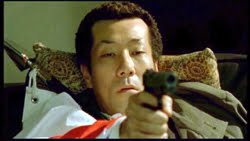
After a decade or so break from the Yakuza genre, Kitano "Beat" Takeshi is at last back at it again with Outrage - and with a vengeance. I've never really been a "fan" of Kitano, but also never really not liked any of his movies; I've always been sort of ambivalent, probably brought on by everyone else worshiping him back in the late 90's when he started getting big in the West (My anti-hipster bent, I suppose). Kitano's last Yakuza film, Brother, was great, and Outrage is even better. I fell for it within the first five minutes, and was hooked until the end - granted, I had to watch it three times to sort everything out, but I guess you could say the fact that I was able to sit through it three full times and still be entertained is an impressive feat for any movie.
Outrage has game on many levels - it's a political thriller following the ins and outs of Yakuza politics of revenge and atonement between bosses, brothers, and cohorts (at least Kitano's vision of it). It's also a solid crime drama; as the drama unfolds, the factions take sides, and when the bullets start flying, you can't help but get caught up in who's going to come out on top, and even cheer for Kitano's group of bad guys. It's also a procedural drama - The way CSI shows you the police procedures of solving a crime, Outrage shows you the procedures of gang war within this fictional Yakuza group. Interesting stuff.
I've gotten so used to Takashi Miike's over the top Yakuza films, and the over the top exploitation Yakuza films starring the likes of Takeuchi Riki, that Takeshi's Outrage comes across as a serious and straight drama - no cartoony violence or outrageous characters here. And although I've read here and there opinions that some of the characters suffer from a lack of character development, the acting is more than solid enough to make up for it. Quentin Tarantino's Reservoir Dogs is a more than apt comparison - both movies are an event, not a character study, but even still the characters are as real as any that have hit the silver screen.
Organizational Chart.
This movie is one in which it really helps to know who works for who, and where everyone sits in the hierarchy. Fortunately for you, I put together the following organizational chart:
Click for full size
I would say this chart covers the good guys, but like the movie poster says, 全員悪人 (They're all bad men). On the other side, you have the Murase syndicate, led by Murase played by Ishibashi Renji (Yakuza Demon, Gozu), who is trying to associate himself with the Sanoukai. The movie follows the antagonizing, retribution, plotting, and revenge that wreaks havoc from the bottom up between these two groups, and when it's all over, you're left wondering if it was a series of random events or a very specific and complex plot that is everyone's undoing. There are good arguments for either side, but I leave it up to the viewer to make that decision when the credits roll. Giving any more details about the plot would be doing you the viewer a disservice (which is why I'm skipping my standard Rundown format of giving a detailed plot outline), there is a lot going on and a lot to follow, but the journey is worth it, and there is a lot of mental popcorn to chew over once it's over. Which is why I recommend a second viewing.
Cast and Characters.
As for the characters, there are some really stand-out performances (vis a vis the Yakuza genre - this isn't Shakespeare, even if it tends toward the Shakespearean). Shiina Kippei gets mad props as the badass VP of the Otomo Syndicate, Mizuno. After an uninspired portrayal of John Rain in the movie adaptation of Barry Eisler's book Rainfall, I really didn't expect much, but fortunately he blew away my doubts. Shiina's Mizuno is dark, violent, and brutal, but not without a dark sense of humor, with a likable personality. As a side note, I had thought that this type of character didn't exist in American cinema, and normally, it doesn't. However after seeing Public Enemies starring Johnny Depp as John Dillinger, I've finally found an American movie that mirrors the characters in Japanese Yakuza films. Dillinger is brutal and dangerous, and yet at the same time charming and personable, and reinforces the legendary image of honor among thieves. These characters, so rare in modern American films, could gut a man with a knife, and then have a beer with friends an hour later as if nothing happened; no guilt, no thought, and no sleep lost. If you want to see an English version of a traditional Yakuza film, Public Enemies is the movie that has characters that could have transferred directly and unchanged over from a Yakuza film. I've read that the Yakuza were inspired in clothing and action by the old American gangster films, and since Public Enemies is rife with Yakuza-like characters, I can believe it.
"Beat" Takeshi Kitano, on the other hand, plays Otomo - the same character he always plays - a laconic, world-weary and resigned Yakuza boss. Really nothing new here. If you've seen a Kitano Yakuza film before, you've seen this character. The only real difference here is that he's just a cog in the Yakuza machine, really not a maverick or outsider, he's just part of the hierarchy.
Renji Ishibashi plays the role that seems to be his typecast - the seemingly perpetually befuddled mob boss - in this case as Murase. He's a bit of an old-school Yakuza that just can't keep up with the ins and outs of the modern Yakuza world, and seems just a little too trusting of the word and motivations of others, much to the detriment of his teeth (in the best and most disturbing dental drill scene I've come across).
All the actors, even the ones who weren't given much to work with, did an exemplary job, which really makes this an A-list movie. Generally speaking, production value tends to be an issue with Japanese movies (read: not enough). But fortunately in the case of Outrage, everything from the quality of the acting, to the cars, suits, and locations, to the digital quality of the film itself, is all top notch. None of the dark and grainy scenes that plague most modern Yakuza films - everything is beautifully lit, the picture and colors are sharp, and the stereo sound is crystal clear. The only caveat is that I'm watching it on a Japanese region DVD on a Japanese DVD player on a 42 inch HDTV. Regardless, you won't find this kind of image quality in any of Miike's Yakuza films of the past decade. The camera work was smooth, and really fit the movie. It fit so well in fact, I didn't even notice it, it doesn't get in the way of the movie, and no camera tricks or creative angles were used to try to enhance the movie. It fit very comfortably in the background, so to speak.
The Violent Rundown.
One thing that does stand out in Outrage is the brutality. Characters are slashed, shot, beat, punched, and whacked with blunt objects with that happens-everyday bland attitude that is the hallmark of the Yakuza genre. Surprisingly enough, rape, another hallmark of the Yakuza genre, is missing (but not missed). This is just a bunch of professional bad guys killing other professional bad guys. As always, my trusty notepad at the ready, I recorded an impressive collection of brutality: Eight beatings, 2 scenes of self-immolation (and the visceral sound of box-cutter on bone is enough to set your teeth on edge), two blunt force head traumas, a facial slashing, 20 shootings, a dismemberment, a spectacularly painful scene of grievous dental trauma via dental drill, massive tongue trauma, chopsticks jammed through an ear, and the hands down winner of best death in a Yakuza film for this year: a spectacular death involving a rope and a car that has to be seen to be believed. All in all some great, and impressively realistic and brutal violence - nothing is stylized, it is what it is - a fun time for all.
The Final Verdict.
Despite the fact that internet reviews of Outrage seem to be pretty polarized between "great" and "sucks", I can't find fault with it. It seems that either people who didn't like it find it too violent, or are disappointed that it seems to lack the art-house angsty existentialism of Kitano's older Yakuza movies from the 90's. But I found it to be a pure drama with nothing stylized or over the top, and rock solid overall. Kitano seems to run a tight ship, there is no fat in this movie, it's a straight, brutal, and direct drama, and that lack of any of the crazy gonzo Miike effects or over the top characters really sets this one apart. The theme throughout is that there is no honor among thieves; everyone is opportunistic, and everyone is out for number one. Even if Otomo and his crew seem to be the protagonists, they all take turns in the reprehensible acts department. There is no hero or anti-hero. Everyone truly is bad, and no one can really be trusted - Think Reservoir Dogs without Mr. White or Mr. Orange. It's a movie that is more of an experience than a story, and yes, you need to experience it. It's not available yet outside of Japan as far as I know, but I assume the grey market will probably have it - and when it hits Blu-Ray in the USA, that will be my cue to buy a Blu-Ray player.
I've been thinking for days how to compare this to the other movies I've reviewed. This is the only straight drama aside from Takashi Miike's Graveyard of Honor that I've reviewed so far, and they both stand out on the top of my list. I have to put this just above Graveyard of Honor for style, production value, and the cast of characters (after all, Kishitani Goro carried the entire movie himself, whereas Outrage has a great cast of characters, and Graveyard of Honor was a B movie at heart, even if it was an A movie). So, as of today, Outrage gets the number one spot in the list of movies reviewed on this blog, and it has something for everyone - violence, intelligent dialogue, plot, and a sense of humor.
Like I mentioned in the introductory post to this blog, it’s rare to find a movie in which the main character is the villain, but when you do, he’s usually likable in his own maverick way, or eventually finds redemption in one form or another (Christian Bale in American Psycho is one evil dude, but he's likable. Anakin Skywalker wasn't terribly likable as a whiny teenager, or as a dark helmet wearing villain, but he did find redemption eventually). However, rarer still is the movie in which the main character as villain not only has absolutely no redeemable qualities whatsoever, but also is thoroughly despicable in every way. Ishimatsu Rikuo, the main protagonist (or more accurately, antagonistic protagonist) in director Takashi Miike’sGraveyard of Honor (新仁義の墓場), is that character. Played with a quiet ferocity by Kishitani Goro, Ishimatsu is similar but different from Kishitani's portrayal of Mizoguchi in "Returner" - a slick badass Japanese sci-fi movie released the same year. Mizoguchi was a classic movie bad-guy, a cold blooded killer with a sarcastic swagger and delusions of grandeur. Ishimatsu isn't even that evolved - he's a fearless brute who takes what (and who) he wants, with no concept of consequences - more animal than human. Ishimatsu isn't your father's honorable rogue. Although Graveyard of Honor has all of the elements of the traditional Yakuza movie, it definitely plays out differently than a traditional Yakuza movie. Well, it ends like a lot of Yakuza movies, but the trip from A to B is a wild, crazy ride. Ostensibly a remake of director Kinji Fukusaku's 1975 film of the same name, it is much more a re-imagining.
Watching the above trailer, I realized something I always knew but never really thought about - the Japanese are great at a lot of things - building cars, anime, hentai tentacle-vomit-bondage porn, and robots, but they totally suck at making movie trailers. They can take any great movie and make it look crappy with really badly edited trailers. I don't think you can really get much of a feel for what's going on in the trailer other than good ole Ishimatsu wreaking havoc on people. But that's why I'm here.
Ishimatsu's start.
Director Miike follows typical convention up front. The movie starts at the end of the story, with the antagonistic protagonist Ishimatsu a prisoner in a jail cell, asking (telling) the guard to let him out to get some air and dry his blanket. The guard eventually agrees to let him out (WTF was he thinking?), and once he and the guard reaches the exit door, the guard is promptly beaten and knocked down the stairs. Ishimatsu goes outside, and climbs to the roof - and we flash back to the story of how he ended up in a jail cell with a wet blanket in the first place.
It turns out that Ishimatsu, a simple restaurant dishwasher, saved a Yakuza boss from an assassin, which gets him quickly inducted into the Yakuza gang, as well as quickly promoted - much to the chagrin of some of the other lieutenants. This quick induction and promotion with no true effort on Ishimatsu's part is probably as unfortunate for him as it turns out to be for everyone else. Somehow up until joining the Yakuza he has been able to keep himself under control and out of jail, and if he had been forced to start at the bottom and work his way up through the Yakuza hierarchy, he would have probably been forced to conform to said society. But suddenly finding himself in a position of power once he enters the criminal underworld where morality is subjective to say the least, whatever ties that kept him under control are gone - the beast is unleashed.
Ishimatsu starts as a loose cannon, but spirals downward steadily as the movieprogresses, and this seems on the surface to be the main theme of the movie, and a favorite subject of director Miike's - the downward spiral. We follow a guy who is a sociopath of one variety or another (but without any attempts at charm or appearing normal - Ishimatsu doesn't even attempt to control himself) who essentially turns out to be too unpredictable even for the Yakuza. You get the feeling that he would be much more suited to a low level position of Yakuza thug, butbeing brought in at a higher level, there is little the other lieutenants can do to rein him in, and as things move forward he spirals downward spectacularly. Unlike Seiji in Miike's epic Yakuza film Yakuza Demon, there is no nobility in Ishimatsu's failure. True to form, and like any good soldier, he proves to be a bloodthirsty Yakuza. Ishimatsu, somewhat like the terminator, viciously stabs a man who owed his Yakuza boss money in a crowded gambling den in front of over a dozen witnesses, and then calmly walks out to the crowded streets of Tokyo, wiping his blood-soaked face and hands on his necktie. This gangster is definitely headed for the slammer.
Ishimatsu and Chieko.
If you have any doubts that Ishimatsu just ain't a good person, let me put those doubts to bed right now. The blood-soaked Ishimatsu finds his way to the woman who will later become his common-law wife, a hostess by the name of Chieko. Played by Arimori Narimi, Chieko looks haunted and perpetually shell-shocked, like a gazelle that just couldn't quite outrun the lion, and considering her first meeting with Ishimatsu resulted her being raped by him, it shouldn't be surprising. At her place, he gives her a very large stack of cash, and the blood-soaked Ishimatsu promptly rapes her again. Later on, while Ishimatsu is in jail, Chieko goes to visit him, and she brings the cash, attempting to return it to him. He tells her to keep it as her allowance. In a scene reminiscent of the pinnacle moment in Jerry Maguire, she asks, "What am I to you?", to which Ishimatsu replies, "My wife". This gangster cuts right to the chase, not a "You complete me" to be heard. She takes the cash and leaves, and when Ishimatsu finally gets out of the stir, she is there waiting for him - I guess he had her at "rape".
Ishimatsu and Imamura Kozo.
Oddly enough, it is in jail where we see a small glimpse of humanity in Ishimatsu. His time in jail is spent with a high level lieutenant from another gang, Imamura Kozo, played as low-key and amicable by Miki Ryosuke, a favorite of mine. Their shared status in the Yakuza seems to endear Ishimatsu to Imamura, although I can't say the reverse is also true - although the otherwise stone-faced Ishimatsu does show some glimpses of emotion in his conversations with Imamura, he proves time and again to base friendship on what the person in front of him can do for him at that moment. Much to his misfortune, Imamura doesn't pick up on this, and feels honor-bound to protect and defend Ishimatsu even when circumstances dictate that he should really be cutting all ties with him.
Ishimatsu and Kikkawa.
The third thread in Graveyard of Honor is Ishimatsu's relationship with his young protege, Kikkawa. Kikkawa starts out working for Ishimatsu directly, and is sort of a young nice-guy type Yakuza out of the gate. While Ishimatsu is cooling his heels in the joint, Kikkawa works his way up in the group, and is eventually forced to harden when he is tasked with hunting his former friend and boss down when he forcibly cuts ties with his "family".
Ishimatsu goes rogue.
After Ishimatsu gets out of jail, he decides to settle down with Chieko (something director Miike doesn't let you know up front, you find out retroactively), and asks his godfather for a loan to buy a hostess bar. It's when Ishimatsu goes to collect the money from the godfather that his fate is sealed. The first line in the movie is a voice-over, which sums it all up: The Godfather went to the dentist with a toothache. In the two hours he was gone... One Yakuza was sent to hell.
The godfather isn't around, and the other lieutenants blow him off, and Ishimatsu basically loses his shit. He figures the godfather never intended to loan him the money for the hostess bar, and begins smashing skulls with a big, heavy ceramic ashtray, and ends by seriously wounding the godfather who took him in. The godfather had intended to give him the loan, but fate decided to step in causing a simple misunderstanding which was blown to the point of no return by Ishimatsu. The remainder of the movie follows Ishimatsu's decent into "hell", and his impact on Chieko, Imamura, and Kikkawa.
Themes.
Although the trip from busting heads at the office with an ashtray to the roof of a jailhouse building is long, sometimes strange, and usually brutal, and although the movie follows Ishimatsu from one scene to the next, I have to wonder if this movie is really about Ishimatsu at all. Ishimatsu is more like a natural disaster - unstoppable, devastating, and can only end badly. The thing about natural disasters is how it affects the people around it. Ishimatsu is like the twister in, well, "Twister", and the deeper threads of the movie are more about how Chieko, Imamura, and Kikkawa are changed or destroyed by the natural disaster that is Ishimatsu.
Chieko.
Chieko's story is one of (misplaced, self destructive) love. Chieko probably wasn't terribly well off before meeting Ishimatsu, but she had a job, and a small apartment. Without any apparent friends or family, she seems to latch onto Ishimatsu. But when the greatest kindness shown to her in the entire movie by Ishimatsu is him giving up his last dose of heroin to her to stop her withdrawals, you have to wonder how much better things might have turned out for her had she never met him. It probably would have saved her a few beatings, rapes, and a wicked drug habit anyway. She follows Ishimatsu into his downward spiral, and while Japanese audiences might find some kind of sublime beauty in Chieko's dedication to Ishimatsu, Western audiences probably won't see much more than a weak and pathetic excuse for a woman.
Imamura Kozo.
Imamura's theme is honor. Imamura Kozo is the archetype of the noble Yakuza. Once he befriends Ishimatsu, he feels honor-bound to support and protect him. After Ishimatsu seriously wounds his godfather and is on the run, Imamura is the only person who is willing to protect him. It is apparent to everyone around Imamura that Ishimatsu is nothing but a dangerous liability, but Imamura stands by his honor and hides Ishimatsu. Unfortunately one of Imamura's lieutenants rats Ishimatsu out to the cops, and Ishimatsu heads back to jail - but only for a minute. He escapes, and goes after Imamura with a vengeance, thinking he is the one who sold him out.
Kikkawa.
Kikkawa is the Yakuza everyman of the story, who ultimately bookends the tale with voiceovers. His theme is a coming-of-age tale of sorts, as it pertains to the Yakuza. Starting out as a young and naive low level Yakuza, he is placed under Ishimatsu as a subordinate. While Ishimatsu is in jail, he slowly works his way up in the group, and when Ishimatsu finally cracks, he is tasked with finding him. Ultimately his path has him removing the thumbs of a former friend to get information, to cutting off his own pinky as atonement for his inability to capture Ishiimatsu, to his final showdown with Ishimatsu that leaves him with a facial scar that, in Japanese pop-culture, is the traditional mark of the Yakuza.
The deeper meaning of the movie is of course left open to interpretation - In the DVD extras (well, my Japanese copy - I have yet to get my hands on the Animeigo version), Kishitani Goro states that he believes that above all else, it is a love story. Arimori Narimi also stated that it was a love story, and actually proclaims her admiration for Chieko. I would say that this statement probably set women's rights back 50 years. Then again, Japan isn't exactly at the forefront of the women's rights movement, so maybe 20 years for Japan. To me Chieko really comes off as nothing more than a pathetic abused woman who keeps coming back for more. Maybe it is a love story, but if so, it just puts Chieko on equal footing with Ishimatsu in the "doomed to their fate" department.
Takashi Miike, on the other hand, stated that he wanted to make a movie about someone who was born a criminal, not someone who became that way. Which makes sense when contrasted with Miike's portrayal of Kikkawa, someone who makes himself a Yakuza out of necessity. Miike makes Ishimatsu someone too self-destructive and brutal to even exist in the world of the Yakuza. Is this his case for the "noble Yakuza" with a code of honor? After all, contrasting Ishimatsu with Kikkawa or Imamura makes the Yakuza appear like the good guys, despite their otherwise questionable morals.
Graveyard of Honor is more a slow burn than an action-packed thriller, with moments of frenetic violence interspersed through the tale of Ishimatsu's undoing. It's a different animal from Deadly Outlaw REKKA or Yakuza Demon, and almost lacks any of Miike's over the top stylized scenes of violence or shock - until the very end, that is. It's much more gritty and slower paced than much of Miike's other work, but it's a welcome addition to the Yakuza genre.
Highlights. Ishimatsu attacking a group of men with a long metal pipe in a bar. The camera follows him down the street to the bar, and the sound of the metal pipe dragging along the pavement just adds to the tension - you know someone's going to get a beat down, but when it comes with swift brutality, it makes for a great scene.
Ishimatsu, strung out on heroin in his boxer shorts in a shootout on a balcony with the police. An odd and crazy scene, it's got to be seen to be believed.
The violent rundown.
By my count, we've got graphic depictions of 12 beatings, three rapes, three stabbings, 11 shootings, 3 scenes of violence against women, and eight scenes of hard-core drug use, needles and all.
Cinematography.
Miike's camerawork gives this movie a more documentary feel than much of his other work, almost like a reality program that follows a day in the life of a Yakuza. Unlike Kinji Fukusaku's original film, the cinematic techniques include prolific use of (but not exclusively) stationary cameras for wide shots – whole scenes are filmed by one stationary camera from afar, some scenes almost to the point of not being able to see the character’s faces. Whereas Fukusaku tilted and twisted the camera, Miike takes the “stationary camera” concept to an extreme – often a character will be out of frame at the start of a scene, and although they are an active participant in the scene, you won’t see them until later in the scene when the camera angle changes. This includes scenes where, partway through, someone enters the scene via a doorway, but stops short of the shot just outside camera range and begins talking. Not being a film student or film historian, I don’t understand this technique or where it may have come from, but I am sure it is not common in the modern Hollywood movie. Also used often in this film are shots from odd angles – shots from chest level into a group of men from a slight distance, almost like the point of view of someone sitting in a chair on the other side of the room.
Final Verdict: This is my first Yakuza film rundown, but my verdict compares Yakuza movies to the genre, rather than to the world of movies as a whole - particularly since most of them would rate as B movies in the greater picture, so it would be pointless to do so. I'll give Miike's Graveyard of Honor high marks for the pacing, subdued violence (subdued in comparison to Miike's more exploitative films), and realistic (again, compared to the director's other work) storytelling style. I have to subtract points for Ishimatsu and Chieko's relationship. It almost seems so corollary to the plot as to be inconsequential, when it seems that it should have been the heart of the story. You never really figure out if Ishimatsu really cares about Chieko at all (and Ishimatsu wanting a loan to buy a hostess bar literally came out of nowhere) - probably intentional, but it makes the relationship seem superfluous. But, at the same time, by not making the relationship the centerpiece, it gives equal standing to the story of Imamura and Kikkawa, and gives the whole movie a deeper subtext.
As I continue to review movies, I'll start rating them against each other for reference. For now, I'll give this movie a point rating of 8 out of 10, for the above reasons.
I hope the blog was worth your time, it sure as hell took me longer to put it together than I expected. Stay tuned for the next movie on my Yakuza menu!


 (新仁義の墓場), is that character. Played with a quiet ferocity by