Around the turn of the 21st century, Kitano Takeshi decided to try to break into the Western film market, and since he’s known for violent gangster movies, it only makes sense that he’d lead with a Yakuza film. Brother was the result. It seems to have gotten generally mixed reviews at best, but it didn't seem to really open up the market for him. He's still pretty much relegated to the dark realm of art house desolation and cinema nerds. Despite all that, Brother is a pretty solid film, albeit with a few minor issues.
Most Yakuza films fall into one of about three categories – ridiculous action crime drama, dark and serious crime drama, or comedic hijinx. Kitano “Beat” Takeshi’s Yakuza film Brother takes a more fantasy route. Much like how the Grand Theft Auto game series imagines a city with a very organized crime structure based on racial stereotypes (The Chinese Triad runs this area, and over here we have the Italian Mafia, and just around that corner we have the black Gangbangers…), Brother takes Los Angeles, and basically does the same thing. Takeshi breaks up LA among various “legendary” crime groups, from gangbangers to cholos to the local Little Tokyo mafia to the actual Italian mafia, and then tosses an exiled Japanese Yakuza member into the mix to attempt a takeover. It seems like Brother treats LA the way that Yakuza groups are portrayed in more typical Yakuza films – gangs that hold certain territories with specific alliances, and by killing a specific member here, and by aligning yourself with another member there, you can effect a city wide takeover. Not sure if that’s even remotely viable in a crime ridden American city with a collection of disparate elements, but that’s what we’re working with here.
The Plot.
The film starts with old school Yakuza member Yamamoto (Played, ,of course, by Kitano Takeshi) in a taxi in L.A., but quickly backtracks to Japan to explain his situation in a typical display of Yakuza film complexity: Yamamoto’s boss is killed in an assassination by another Yakuza group, the Jinseikai, which then absorbs his group into it. Yamamoto isn’t having that, so to get him out of the way, his former partner Harada (Osugi Ren from Party 7, Tokyo Mafia: Yakuza Wars, and Fireworks) is tasked with killing him by the new boss, played by Japanese film legend Watari Tetsuya (Tokyo Drifter, Yakuza Graveyard, andGraveyard of Honor). Yamamoto, in true badass fashion, offers Harada his own gun to kill him. Harada refuses; they’re sworn brothers, after all. So he sends Yamamoto to America and kills and mutilates a bum to pass off as Yamamoto’s corpse. Now Yamamoto is free and clear of the Japanese Yakuza and on his way to Los Angeles to find his younger half-brother, Ken (Claude Maki, A Scene at the Sea). Convoluted enough for you? Fortunately the rest of the plot is pretty straightforward.
Yamamoto finds Ken living with his drug-dealing hoodlum buddies Denny (Omar Epps), Jay (Royale Watkins), and Mo (Lombardo Boyar). It should be mentioned that Yamamoto is taciturn and expressionless (as nearly all of Kitano's roles tend to be), and one would imagine that now that his ties have been cut from the Yakuza he is world weary and finished with that life. Oh, but no. On the contrary, Yamamoto quickly inserts himself into his younger brother’s drug dealings, with decisiveness and swift violence. Apparently the expressionless Yakuza has no interest in retirement. Why the hell he wants to push in on territory that he knows nothing about, and with no real resources is a mystery, but I guess it’s just part of the fantasy.
The first act is Yamamoto effecting a takeover of the small time gangs in the area and consolidating power. The second act abruptly starts with the “family” now holding real power, having transitioned from a ghetto apartment to a high-end fancy loft complete with a basketball half court and an accountant, and some of the coolest suits ever put to film. The abruptness with which the movie shifts forward into the future is jarring, and it takes some time to figure out that probably a few months or more has passed – the actual amount of time is never made clear beyond the fact that so much has changed. It has to be a pretty good amount of time based on the visual cues.
Anyway, after this indeterminate amount of time has passed, they are making real money, and looking to cut into the Italian mafia’s territory – which, if you've ever seen a gangster film, is never a good idea. However, when your strategy as a drug dealing Yakuza crime boss is really nothing more than to kill anyone that gets in the way of your plan, I guess expansion is the only option.
The main focus of the film, aside from the violence, is the friendship that develops between Denny and “Aniki” (Denny’s term for Yamamoto, Yakuza-speak for “brother”). They have a good enough chemistry on screen, and the ending hinges on the viewer buying into the friendship in the first place, but I don’t think quite enough development was put into the friendship to give the ending the impact that it really wants.
The Characters.
Aside from Yamamoto, there is a large collection of characters, although mostly bit players and background filler – only a few characters of note. Most notable is my personal favorite, Susumu Terajima (Shark Skin Man and Peach Hip Girl, Gonin 2, Ichi the Killer, Sonatine) as Kato, Yamamoto’s most loyal lieutenant, and Kato Masaya (Shinjuku Incident, Agitator) as the Little Tokyo mob boss Shirase. Also worthy of mention is Ishibashi Ryo (Another Lonely Hitman), as Shirase’s right hand man Ishihara.
The Violent Rundown.
As in any good Kitano Takeshi film, there is a healthy helping of violence. We are treated to the brutal beating of a drunken bum, a broken bottle to the eye, two stabbings, a pair of broken chopsticks up the nose, a car bomb, around 13 shootings including a Russian Roulette style suicide, and probably another 10 more off-screen shootings. As this is a yakuza film, things wouldn't feel complete without the two hacked off fingers and a good old-fashioned disembowelment.
The Final Verdict.
Brother is a good introduction to Yakuza films for English speakers who aren't familiar with the genre. It hits on all the typical Yakuza themes, is probably 80% English, and dishes up a big serving
of gangland violence. As for the overall plot, well, the underlying point of the movie is never really made all that clear, and is pretty much left up to interpretation. Is the point the “friendship across cultures” between gangsta Denny and gangster Yamamoto? Is it the parable of the old Yakuza who can’t change his ways? Or, is it simply a “suicide by crime spree” on the part of Yamamoto, who has been banished from not only his country, but his entire Yakuza identity? I dunno.
Brother isn't a bad film, and if you’re a fan of the genre, there is plenty here to like, and since it is sort of an experiment in crossing cultures plot-wise, and production wise, it turns out to be a generally entertaining experiment that was only a failure insofar as it failed to get Kitano the international exposure that he wanted. I guess it was panned because it feels like a B movie, and probably because of the terrible editing and jarring scene transitions that plagued it throughout, along with some weak acting here and there. But, see it anyway.
It's time to wrap up 2010 with the best and worst of the Yakuza films reviewed this year. Six films have been reviewed this year, and here is the list:
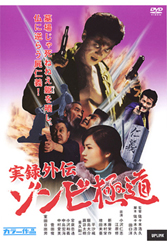
6.Yakuza Zombie. A bumbling low-level Yakuza who is double crossed and killed is reanimated by the spirit of a vengeful Yakuza. It wasn't an outright obvious comedy, but it was pretty preposterous, so I'm assuming it's a comedy, but you just can't tell; that worked against it - it's too ridiculous to be a completely serious movie, but there is very little straight comedy, so it's hard to figure what to make of it. A solid cast, a goofy plot and low budget (as in, I couldn't tell if it was made for video or made for network TV), Yakuza Zombie pulls up the rear for the Rundown's reviewed films.
5.Another Lonely Hitman. Not the worst I've seen this year, but the painfully slow pace really hobbled this one for me. Short on action, long on non-action - it's trying to be a hipster art film when it's just a Yakuza film. I don't really know if the Yakuza genre lends itself to artsy character study, but it didn't really do it for me - in this case, it didn't put itself in one genre or the other strongly enough, so you're sort of left with a Yakuza film that has long scenes of stage-setting and character study. Because it's one of the bridges between the old school and new school of Yakuza films, it's worth a look, but don't get your hopes up too much.
4.Wild Criminal. Wild Criminal straddles the line between crime drama (like Gonin) and Yakuza film - no stereotypical scenes of Yakuza in their Yakuza office sitting around smoking and yelling at eachother across a table, this is mostly the outer reaches - the Yakuza-run clubs and casinos. As usual both Ozawa Hitoshi and Riki Takeuchi deliver the goods, and there is a good twist at the end that I feel like I should have seen coming, but didn't, so kudos to the director or scriptwriter there. Basically this is a standard Yakuza movie with a crime-drama bent, and probably easier for the average movie buff to digest because there aren't as many cultural quirks to confuse the viewer not familiar with Japan.
3.Like a Dragon. Takashi Miike does his thing again with a Yakuza movie based on a video game, and although this is normally a recipe for disaster, Miike pulls it off almost brilliantly (note: almost), with the help of a bad ass Kitamura Kazuki, and the absolutely over-the-top Kishitani Goro. Kishitani is the biggest show stealing bad guy since Jack Nicholson in the original Batman, and maybe even more so. This one has respectable production value, although it looks like nearly all of it was filmed on a soundstage, but that doesn't take away from anything - what does is the ridiculously convoluted plot. I had to watch it three times to get it all straight - I suppose if you've played the videogame it already makes sense, but for the rest of you, you can read the Yakuza Film Rundown review, where I break it all down.
2.Shinjuku Incident. I'm sure this has been described as "Scarface in Tokyo", and that's right - Shinjuku Incident is a near epic. Having seen Jackie Chan in so many goofy roles I was blown away - maybe that's my fault for not seeing any of his serious stuff before (and I'm sure neither has any other average Joe, so fuck off), but Jackie was brilliant, as was the entire Chinese cast. Surprisingly Masaya Kato brought very little energy to the role, and after seeing him in movies like Brother, Blood Heat, and Agitator, I expected a lot more, because I know he can deliver - so who gets the blame? The director? Masaya himself? Not sure, but it was passable but not above and beyond like I would have normally expected. I was also a little disappointed that Jackie Chan wasn't more of a bad guy, in the end he held on to his good guy image. That aside, Shinjuku Incident was a great movie, and I watched it three or four times in the space of three weeks while writing the original review - it was that good. Rent or buy, do whatever you want, just see it.
1.Graveyard of Honor. Graveyard of Honor, directed by Takashi Miike, deserves the number one spot - it's brutal, violent, disturbing, and damn near perfect. I first saw it in Japan in 2004, and watched it three times before returning it to the rental place. Kishitani Goro owns the role of Ishimatsu in a terrifying display of what should be an award winning example of method acting. Not only is he completely believable as a brutal psychopathic Yakuza, and composes the nuances of the near-emotionless demon perfectly, but he becomes Ishimatsu.
The rest of the cast can't be sold short, either - Miki Ryosuke is a great supporting actor, and Arimori Narimi is perfect as Ishimatsu's pathetic and abused lover. If you only see one Yakuza movie in the next 12 months, it should be Graveyard of Honor - It is a grand display of Takashi Miike and Kishitani Goro's skills as filmmaker and actor, respectively. Graveyard of Honor has so many underlying themes and nuances, it takes multiple viewings to take them all in.
Some probably see it as little more than a showcase for violence, but in the big picture, there is so much more, so get it on Netflix or buy it now!
I took a chance and got my hands on Jackie Chan's 2009 Shinjuku Incident - believe it or not, a Chinese-directed Japanese Yakuza film, and was actually shocked at what I found. Jackie Chan can really act! Considering his endless stream of mindless fight movies, comedies, and comedic buddy movies, and other combinations of the sort, I really didn't think he had it in him to pull off a serious role. Like I said - shocking. But in a good way.
Jackie has put together something between a cautionary tale of the difficulties and dangers of being an illegal immigrant and Scarface, using Japan as the backdrop, and Tokyo's Shinjuku district as the location. In an interview, Jackie claimed that the movie was basically a compilation of true stories of illegal immigrants to Japan, which I can't really speak to with any sort of authority, but the smaller events seem plausible enough even if there are aspects of the overall plot that doesn't. One thing is for damn sure, and that is, it sucks to be an illegal immigrant, although as of July 29th, 2010, or so, China has surpassed Japan as the world's second largest economy, so it seems that now it would be a step down for a Chinese to sneak into Japan. In Jackie's interview, he nearly begged people to consider staying home rather than illegally immigrating somewhere where you will have no rights, respect, or an ability to speak the language - per Jackie, anything's better. I believe this was a veiled reference to Canada - Stay North of the border where you can be with your own people speaking your native language - nothing but a sad, dangerous life awaits you South of the border.
Normally when you have a movie with an international cast, you get poorly written dialogue, and/or B actors filling the roles of the non-dominant nationality (Take Karate Kid 2 as a prime example - Japanese rolls filled by non-Japanese and non-native speakers of Japanese, which left poor Japanese dialogue in foreign-accented Japanese), but in this case you get perfectly natural Japanese dialogue, delivered by the legendary actor (at least in my mind) Takenaka Naoto, and undisputed Japanese movie star Kato Masaya (Agitator, Aragami: The Raging God of Battle, Brother) as a police detective and Yakuza boss, respectively. Not to mention a great Japanese supporting cast. On the Chinese side the cast is equally as solid, with a great performance by Jackie Chan himself - so good in fact, it's easy to forget you're watching Jackie Chan, the actor. Daniel Wu (as Jie, or "Joe" in the English subtitles) hits a home run as Nick's younger brother, and takes him from the cheerful, happy-go-lucky roasted chestnut peddler into a downward spiral that ends with him a mere haunted ghost and drugged-out shell of his former self.
Also of note is the portrayal of the city of Tokyo in the movie, which was excellent. Great location shoots in Tokyo and Shinjuku, and per Jackie Chan, he had to get permission from the Yakuza to film there - to which they responded, "Come on over, Jackie!" (My Chinese co-worker gave me the inside scoop that the Yakuza welcomed Jackie Chan with open arms because he is an aniki in his own right in the Chinese mob - we'll leave that one TBD). It's always nice to watch a movie and be able to spot places you've walked past or had lunch at. Shinjuku Station should be familiar to anyone who has been to Tokyo. I've sat there and ate a bento staring up at the giant TV screen more than once myself.
There is more than one trailer for this movie floating around online, but I decided to go with the Japanese version - mainly because I was shocked that it didn't suck - Japanese movie trailers are notoriously horrible. The original, High-Def English international trailer is available here.
The Plot.
Steelhead (鉄頭) or "Nick" in the subtitles (where they came up with "Nick" I'll never guess - Nick from nickle which is a type of metal, just like steel...?) is a poor but happy Chinese mechanic, who's girlfriend Xiu Xiu, goes to visit her aunt in Tokyo and seems to eventually drop off the map. Even Nick's brother Joe in Tokyo can't seem to find her. So Nick does what any good poor country boy does - he becomes an illegal immigrant and takes a boat to Japan, which, fortunately for him, sinks just offshore Tokyo, close enough for him to find his brother Joe in the massive city in a mere two days.
Nick is taken in by his brother and a hoard of illegal compatriots, and does what every illegal immigrant does who is worth his salt - he takes every menial manual labor job that comes around, from separating recyclables at a dump to cleaning sewers - all the while trying to keep a low profile. Eventually he ends up on police radar during a police sewer-raid, and meets his future foe and friend, Inspector Kitano, played by Takenaka Naoto. Takenaka is like the Ed Harris of Japan, and not just because he's bald - he's absolutely ubiquitous in Japanese film and TV, and has the acting range of Ed Harris (1996's Taiga Drama Hideyoshi, Azumi, Gonin, Rampo, Shall We Dance?, Freeze Me, Muscle Heat, Agitator, Water Boys, and so, so much more) - purported to never turn down a role, he keeps turning up like a bad penny, except... well, good.
Nick eventually finds his lost love, Xiu Xiu - it turns out she's gone native; she's changed her name to Yuko, and has married a Yakuza boss named Eguchi Toshinari, second in command of the Sanwa-Kai, played by Kato Masaya. Kato Masaya has played some hella cool gangsters in the past, but now that he's pushing 50, he's playing a more mature Yakuza (I might even throw in "sedate") - a heavy contrast to his portrayal of Kunihiko in Takashi Miike's 2001 movie Agitator (荒ぶる魂たち). Eguchi is an ostensibly open-minded Yakuza when it comes to race relations, at one point stating "I wouldn't discriminate against Chinese" - a statement that seemed awkward - he's got a Chinese wife and a half-Chinese daughter, that should be enough for the audience - I have to admit I hate it when directors go out of their way to point out the obvious. I also have to question just how realistic it is for a high-level Yakuza to marry a Chinese former hostess - guess it's not implausible, but it does seem contrived.
Everything seems to be going OK for Nick and Joe as illegal immigrants at first - Nick makes peace with the fact that his lost love, Xiu Xiu, really is lost to him, so he organizes his Chinese clan into a small time criminal gang specializing in petty theft, shoplifting, selling counterfeit telephone cards (which were the territory of the Iranians while I was living in Japan) and buying high end merchandise with stolen and fake credit cards, all in an attempt to build a life for everyone in Japan. And in a touching scene younger brother Joe is gifted with a chestnut wagon, since he's "too nice to be a criminal". Unfortunately, things go bad for Joe. When Joe mistakenly gets caught up in a plot to steal from the Taiwanese Triad via a rigged Pachinko machine, the Taiwanese boss slashes him across the face, and hacks his right hand off, leaving him scarred and broken, mentally and physically. This event changes everything for the Chinese immigrants, and sends Shinjuku Incident into the direction it was meant to go from the start.
Nick takes off for revenge against the Triad boss, and in doing so ends up foiling an assassination attempt on Eguchi's life. Seeing Nick's potential, Eguchi asks Nick to kill two key members of the Sanwa-Kai, which will put Eguchi squarely in charge. In return he agrees to get Nick legal status in Japan, as well as all of the Taiwan Triad's Shinjuku territory. And so begins Nick's Scarface-like rise to power in Shinjuku. However, unlike Tony Montana, Nick is a reluctant criminal - his intentions are to support his friends and new immigrants, getting them legitimate businesses, but Eguchi's influence drags everyone around him, including his brother Joe, into all manner of vile and illegal enterprises, and Eguchi's ostensible support of the Chinese brings the wrath and power of the Sanwa-Kai to bear on all of them for an epic showdown.
Highlights.
All in all, Shinjuku Incident is a very consistent movie, there isn't a lot of overcompensating with action or violence to shore up any weaker scenes (although the two scenes of Nick as Yakuza Hitman were very well done). In fact, the highlights of Shinjuku Incident are the scenes taking place in public places in Shinjuku. Shinjuku is well represented, and it really looks like director Yee and Jackie Chan had free reign to film wherever they wanted. You never doubt for a moment that the film was shot directly in Shinjuku. It really is a coup for the movie, since lots of outdoor scenes of well known places do seem hard to come by in many movies shot in Japan.
The Violent Rundown.
With my trusty pen and paper I came up with a tally of 5 stabbings (my best guess with the general mayhem at the end), 7 shootings, 3 beatings, two dismemberments, and a killing with a rock to the head. All in all on the higher side of violence of the movies covered on the Rundown so far.
The Final Verdict.
Shinjuku Incident really is an epic film, and done correctly really could have been an hour longer. Part way through, there is a cut to an unspecified point in the future (My best guess is 2-3 years later), which really could have been filled in with some detail. That being said, director Yee did an amazing job - Shinjuku Incident is a solid addition to the Yakuza genre. Great locations, great production value, and great acting. I still can't quite believe this is the same Jackie Chan from The Big Brawl and Rush Hour. It turns out Jackie Chan is an actor after all.
It is a little unfortunate that Jackie doesn't let go of his good-guy image - everything he does in the film is partly to build a better situation for his Chinese compatriots, and partly because he has no other choice. It would have been interesting to see a "bad" Jackie Chan, but it would have also resulted in a different movie. Despite this, he pulls off a great performance, and at a much higher production value than the typical Japanese Yakuza movie. I'll put this above Like a Dragon, since it is a more serious addition to the genre, with a more interesting plot, but just below Miike's Graveyard of Honor, since it just barely falls short of Yakuza film convention, as Nick never really is forced to tread on the grounds of immorality, regret, or doubt until the very end - and he never has to give up his humanity along the path. Instead, Daniel Wu is installed as the fall guy as Joe, to protect Jackie's good-guy image.
All in all a film well worth the time to see, and is available from the Yakuza Film Rundown via Amazon.com. Don't forget to place your vote on the upper right of the blog for the next Yakuza Film Rundown, and feel free to leave comments below - I'd very much appreciate the feedback - I'm always looking to come up with new ideas and new angles for the blog.