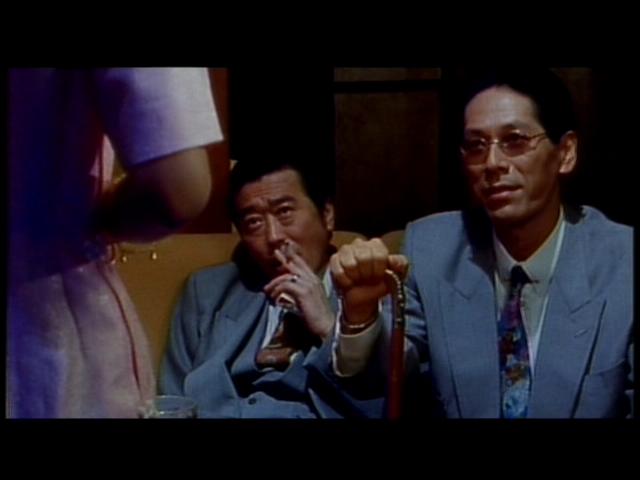
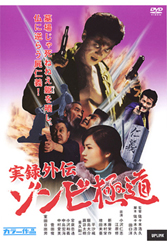
With 2011 drawing to a close, we are going to revisit the Yakuza movies that were dutifully examined this year with the first annual Yakuza Film Award Show. Five movies have been reviewed this year, and each, in their own way, had something to offer. So we'll be highlighting those offerings by awarding the best of the best with The Yakkie - a golden statuette of Takeuchi Riki. Nothing says ridiculous Yakuza mayhem like Takeuchi Riki, so what would be more fitting than a golden statue in his honor to award the movies in contention this evening?
It took a lot of thought and debate from the Yakuza Film Academy, and after much debate, three stabbings, and a shooting, consensus was at last reached. The categories were developed with much thought, and the most deserving winners will go home tonight with a scowling Yakkie to put on the mantle in a display of epic awesome that they have earned with blood, sweat, tears, and a back alley mortal combat death match. The movies in contention for the epic golden statue are all of the ones that were reviewed in 2011.
So, without further ado, on with the show. Tonight, we have a variety of categories that touch on all of the important things in Yakuza films, like death, destruction, and bravado. Our first category is:
Biggest Show of Epic Badassery.
There was a fight to the death for this category, as after all badassery is the staple of the Yakuza film. However, the creative self-mutilation in the name of preserving one's Yakuza honor displayed in Tokyo Mafia: Yakuza Wars (1995) clinched the win for Takeuchi Riki. Sure, cutting off your own finger as an act of contrition already smacks of bad-ass, but Takeuchi Riki took it a step further - he bit off his own finger. And in the eyes of the judges, that's just beyond bad-ass. Well deserved, in my estimation.
Best Lunatic.
Most Yakuza films have crazy people. It comes with the territory. But outright lunatics are fewer and farther between. Had Takashi Miike's Like a Dragon been reviewed this year, Kishitani Goro would have taken home the gold with his portrayal of Majima. But since he's not in the running, the Yakkie for Best Lunatic goes straight into the hands of Jo Akio for his portrayal of the nameless psychotic Chinese gangster-assassin in Blood. Without any dialogue to speak of, this lunatic killer offs his victims by suffocating them with plastic bags, all the while with a wide-eyed frozen grin. I'm not sure if it's creative brilliance or pure uninspired hackery, but it stood out, and that's what counts.
Most Derivative Yakuza Film.
1995's Score was a heist movie in more ways than one. It stole liberally from Reservoir Dogs, Pulp Fiction, and, oddly enough, Jean Claude Van Damme's movie Hard Target. And when I say stole, I don't mean it was inspired by, but that it literally took everything from costumes to concepts to plot points to actual scenes, and recreated them. Normally that kind of thing will get you sued, but in the case of Score, it scored it a golden statuette. The movie was interesting enough, if for no other reason than to see the variety of ways it recycled old movie parts from Quentin Tarrantino and John Woo, and so the win is well deserved. After all, every movie needs a gimmick, even if the gimmick in question is that is rips off entire plots and scenes from another movie. It's a valid gimmick.
Film with the Most Random Characters.
Katsuhito Ishii's Party 7 was short on plot and purpose, but it did have an interesting cast of eclectic characters. Everyone from the bumbling Yakuza, Miki, to his super hot ex-girlfriend to her strange and wimpy current boyfriend, to Captain Banana and Okita Soji, to everyone else - they each bring something to the table, even if it's just a little quirk or odd manner. Miki is the presumed main character, but everyone gets equal play, and in a movie where the plot doesn't really matter, that's important. And each character is so random and wildly different than the next, it helps keep an otherwise pointless movie interesting.
Most Creative Death Scene.
In standard Yakuza films (outside of some of Takashi Miike's more bizarre outings), deaths are pretty standard - bullet to the head, knife to the gut, etc., but in Takeshi Kitano's 2010 Yakuza outing, Outrage, creative uses of brutality become the standard. You've probably seen the clips on YouTube of heads smashed with rocks, epic uses of rogue dentistry, gunshots and bomb blasts, but the one stand-out kill of Outrage (Spoiler Alert) is the death of Kippei Shiina's character Mizuno. I'll limit the spoiler by saying it involves a car and a length of rope, and it falls into the realm of "more difficult than it's worth", sort of like the bad guy in a James Bond movie using a slow-moving lazer to eviscerate the hero who is tied to a table, when a bullet to the head would be much more expedient. Either way, kudos to Kitano for coming up with it - this is why we watch Yakuza movies in the first place.
Most Violent Film.
And now for the Yakuza Film Rundown's version of Best Picture - the most violent film of 2011... and the award goes to Takeshi Kitano for Outrage. Outrage didn't have the biggest body count of the films reviewed in 2011 - that would probably go to Blood - however Outrage displayed some of the most visceral and disturbing violence of any movie reviewed this year. Kitano was apparently making up for lost time with his latest flick, and that's why we love it - mean spirited gangsters killing each other off in betrayal after betrayal with uninhibited brutality, and without even the morbidly comforting pretext that it was justified; that's just how these guys are, and the win is well deserved.
That's it for the Yakuza Film Rundown awards for 2011, see you next year, where we'll be bringing you even more reviews of films from the Yakuza film genre. And more violence.
Extensive reviews of the best Yakuza films, by the gangsters who brought you the Samurai Archives.
Showing posts with label Riki Takeuchi. Show all posts
Saturday, December 31, 2011
Friday, June 17, 2011
Blood (1998)
Takeuchi Riki's 1998 (presumably- no make that very likely) straight to video flick Blood
(Wolf's Blood in Japanese) is a B movie in the same vein as Wild Criminal - part Yakuza film and part crime drama. Takeuchi's bread and butter is playing good guys who do bad things, and the character of Nakajo Takuya fits the bill. He's a seasoned killer-for-hire who (in the stereotypical fashion of these types of movies) kills without a thought. But no matter how bad ass Takeuchi plays things, he always brings enough humanity to his roles to show that no matter how tough the guy is, there is some good stowed away there somewhere. Either that or he just plain wants to hold on to a little bit of the movie hero image.
The Plot.
In the case of Blood, Nakajo Takuya was a good guy with a good girl back in highschool, when he was attacked by some punks and his girlfriend was raped. His best friend Kamiyama Masayuki (played somewhat blandly by Takachi Noboru, and who looks kinda like Kane Kosugi) saves the day by killing one of the punks with a knife (I'm suddenly having flashbacks to The Outsiders), and the others flee. Takuya can't let his friend take the rap for killing the punk that was raping his girlfriend, so he turns himself in to the police instead, and goes to jail, where he changes his name to Kizaki and apparently became a cold-blooded killer. His old buddy Masayuki, free and clear of the cops, marries Takuya's former girlfriend Yuki, and goes to medical school to become a doctor - which is fortunate for Takuya, since the next time they meet he's dying in an emergency room, only to be saved by his old friend.
It also turns out that the very crime boss that is trying to kill Takuya is also a patient of Masayuki's by the name of Ri, who happens to be dying from terminal bone cancer. Unfortunately for Masayuki and his wife, when the crime boss (played by Hakuryu) finds out that Masayuki and Takuya are old friends, he decides to use this to his advantage, forcing Masayuki to kill Takuya in exchange for the life of his wife.
Very little in this movie stands out. Sure, the script isn't unintelligent or bad, but take a typical Takeuchi Riki straight to video movie, toss in a few stock concepts, sprinkle with an colorful character or two, shake well, and voila.
The Cast and Characters.
Most of the characters are bland, including Masayuki, and Takuya, is well, nearly every B movie character Takeuchi has ever played. And Hakuryu plays the crime boss Ri as simply a serious guy - no over the top craziness that you'd see from Ozawa Hitoshi, for example. My assumption is that Hakuryu downplays everything because this is a man who will be dead in six months from cancer, but it makes for a sort of uninteresting performance. The issues Ri may be wrestling with aren't even really tackled in this movie, so Hakuryu isn't given much to work with anyway. I know Hakuryu has been in many Yakuza films (although none actually come to mind) but this would be one of his less impressive performances.
One standout performance, mainly because it's so over the top is the pinheaded Chinese killer with a perma-grin that works for Ri. Unfortunately I'm at a loss as to who plays him since I can't seem to find it anywhere, but it's one little thing that helps an otherwise dullish movie. Another oddity would have to be the grandma assassin (as in a grandma who is an assassin, not one who kills grandmothers) - I'm not sure why the director chose to put in an old lady assassin, but again, another oddity to help distinguish this movie from others.
The Violent Rundown.
Blood was barely average for violence. It does start out right in the shit with three executions (and one of the victims looks suspiciously like Rokkaku Seiji, who played the chubby Assassin in Takashi Miike's 13 Assassins), and follows with 12 shootings, 2 snapped necks, 6 stabbings, one partial rape, one slashing, 2 strangulations, and someone getting blown up. Like I said, average.
The Final Verdict.
Blood really doesn't offer much more than an uninteresting story with a light dusting of a few interesting characters and a couple scenes of acceptable violence (the coolness meter registers a slight tick, nothing stunning by any means). It is about on par with Tokyo Mafia: Yakuza Wars as far as quality goes, but without the slightly more interesting story and better cast. Blood is a B movie in every way, and only could really appeal to three types of people - Yakuza film fans, Takeuchi Riki fans, and people who just have to see all Japanese movies. Blood is not terrible in the same way that Tokyo Mafia: Yakuza Wars isn't terrible. It will satisfy people who are interested in the subject matter or some aspect of it, but probably won't do much for anyone else. Personally, I didn't hate it, but enjoyed it least of all the movies I've reviewed so far, with the possible exception of Yakuza Zombie. I can barely rank it above Yakuza Zombie as a film, but with a gun in my face and my back to the wall forced to choose, I'll put it just above, mostly because Yakuza Zombie was so much more ridiculous. You can view the trailer for Blood here.
The Plot.
In the case of Blood, Nakajo Takuya was a good guy with a good girl back in highschool, when he was attacked by some punks and his girlfriend was raped. His best friend Kamiyama Masayuki (played somewhat blandly by Takachi Noboru, and who looks kinda like Kane Kosugi) saves the day by killing one of the punks with a knife (I'm suddenly having flashbacks to The Outsiders), and the others flee. Takuya can't let his friend take the rap for killing the punk that was raping his girlfriend, so he turns himself in to the police instead, and goes to jail, where he changes his name to Kizaki and apparently became a cold-blooded killer. His old buddy Masayuki, free and clear of the cops, marries Takuya's former girlfriend Yuki, and goes to medical school to become a doctor - which is fortunate for Takuya, since the next time they meet he's dying in an emergency room, only to be saved by his old friend.
It also turns out that the very crime boss that is trying to kill Takuya is also a patient of Masayuki's by the name of Ri, who happens to be dying from terminal bone cancer. Unfortunately for Masayuki and his wife, when the crime boss (played by Hakuryu) finds out that Masayuki and Takuya are old friends, he decides to use this to his advantage, forcing Masayuki to kill Takuya in exchange for the life of his wife.
Very little in this movie stands out. Sure, the script isn't unintelligent or bad, but take a typical Takeuchi Riki straight to video movie, toss in a few stock concepts, sprinkle with an colorful character or two, shake well, and voila.
The Cast and Characters.
Most of the characters are bland, including Masayuki, and Takuya, is well, nearly every B movie character Takeuchi has ever played. And Hakuryu plays the crime boss Ri as simply a serious guy - no over the top craziness that you'd see from Ozawa Hitoshi, for example. My assumption is that Hakuryu downplays everything because this is a man who will be dead in six months from cancer, but it makes for a sort of uninteresting performance. The issues Ri may be wrestling with aren't even really tackled in this movie, so Hakuryu isn't given much to work with anyway. I know Hakuryu has been in many Yakuza films (although none actually come to mind) but this would be one of his less impressive performances.
One standout performance, mainly because it's so over the top is the pinheaded Chinese killer with a perma-grin that works for Ri. Unfortunately I'm at a loss as to who plays him since I can't seem to find it anywhere, but it's one little thing that helps an otherwise dullish movie. Another oddity would have to be the grandma assassin (as in a grandma who is an assassin, not one who kills grandmothers) - I'm not sure why the director chose to put in an old lady assassin, but again, another oddity to help distinguish this movie from others.
It bears mentioning that Sugata Shun also has a small cameo at the end. It also bears mentioning that this would have been a better movie if he had a larger role. As an aside, one actor who definitely was NOT in this movie was Aikawa Sho - even though until I fixed it, IMDB said he was, and quite a few other sites also said he was in it. However, a close look at the DVD case of the American release of Blood shows someone who really does look suspiciously like him. So maybe he's in the director's cut? If anyone knows, let me know.
There are a few good violent scenes, including Takeuchi Riki taking out bad guys First Blood style, and an ending that I suppose wants to be cool, but doesn't quite pull it off. It is vaguely similar to the ending of Yakuza Demon, however not nearly as well done. Which takes us to the violence tally.
The Violent Rundown.
Blood was barely average for violence. It does start out right in the shit with three executions (and one of the victims looks suspiciously like Rokkaku Seiji, who played the chubby Assassin in Takashi Miike's 13 Assassins), and follows with 12 shootings, 2 snapped necks, 6 stabbings, one partial rape, one slashing, 2 strangulations, and someone getting blown up. Like I said, average.
The Final Verdict.
Blood really doesn't offer much more than an uninteresting story with a light dusting of a few interesting characters and a couple scenes of acceptable violence (the coolness meter registers a slight tick, nothing stunning by any means). It is about on par with Tokyo Mafia: Yakuza Wars as far as quality goes, but without the slightly more interesting story and better cast. Blood is a B movie in every way, and only could really appeal to three types of people - Yakuza film fans, Takeuchi Riki fans, and people who just have to see all Japanese movies. Blood is not terrible in the same way that Tokyo Mafia: Yakuza Wars isn't terrible. It will satisfy people who are interested in the subject matter or some aspect of it, but probably won't do much for anyone else. Personally, I didn't hate it, but enjoyed it least of all the movies I've reviewed so far, with the possible exception of Yakuza Zombie. I can barely rank it above Yakuza Zombie as a film, but with a gun in my face and my back to the wall forced to choose, I'll put it just above, mostly because Yakuza Zombie was so much more ridiculous. You can view the trailer for Blood here.
Labels:
Blood,
Hakuryu,
Riki Takeuchi,
Sugata Shun,
Takachi Noboru
Saturday, April 30, 2011
Tokyo Mafia: Yakuza Wars (1995)
Takeuchi Riki, the undisputed world heavyweight champion of V-Cinema stars in the four-part epic (well, not really epic - it's no Dune) Tokyo Mafia. The first movie in the four part series is Tokyo Mafia: Yakuza Wars, which tells the tale of an ex-Yakuza member, Yabuki Ginya (played of course by Takeuchi) who builds his own syndicate from the ground up, first just to make a buck, but by the end of the movie, his goals become more lofty: to take over all of Kabukicho in Tokyo! (Cue dramatic music here). Kabukicho, of course being the setting of many a Yakuza film. I haven't been to Kabukicho since 2004, but it would be an understatement to say that it had its share of strange and creepy people lurking about.
The Plot.
Ginya Yabuki is a successful criminal on the fringes of Kabukicho, dealing in whale meat and flash memory chips (apparently hot technology back in '95) with a small group of six comrades (explained later as more of a secret society than an actual Yakuza group). But it wasn't always like this. Yabuki used to be a member of the Yamaryu crime syndicate. However, by cozying up to the boss he earned himself a major beat down from the 2nd in command of the Yamaryu group, Iwagami (Played by Yakuza film veteran Osugi Ren, from Sonatine, Shinjuku Triad Society, and can be seen snorting a 15 foot line of coke in Dead or Alive). After getting his face bashed in and an ashtray to the head, Yabuki turns the tables on the overzealous Iwagami by pulling a gun and shooting him in the leg. He bites off his pinky in a spectacular show of badass atonement for his actions, and resigns from the syndicate, followed by his well meaning but not so bright lackey, Yuki, played by Ozawa Kazuyoshi (That's right, the younger brother of always awesome Ozawa Hitoshi from Yakuza Zombie and Wild Criminal).
Nowadays, Yabuki is content to make his cabbage in deals with the various criminal organizations around Tokyo, including the Chinese mafia (who have a habit of cutting off limbs of people who oppose them), and spreading the cash around the guys in his little group - including some white dude named "Smith" (who doesn't seem to speak any Japanese and never really says anything beyond "OK Boss", but who I also swear I've seen in the same role in other Yakuza films). But, as the money rolls in his small cadre starts to grow, and his old Yakuza connections start to get interested in Yabuki's goings-ons. His old friend Sho Saimon helps broker a deal between Yabuki's group and the Yakuza. But quickly the various Yakuza groups want a bigger piece of the pie, and in the words of Yabuki, "Can 70 men stand against 3,000?"
The Characters.
When Takeuchi Riki is handed a script, he seems to take his slide-rule that extends from "good-natured" to "badass", slides it in one direction or the other, and that's how he plays it - some in the biz would call that "limited range". I prefer "consistent". In this case, the Rik-O-Meter was cranked mostly over to the "good natured" side. Takeuchi was still badass enough to bite off his own pinkie finger, but even that show of badassery pales in comparison to many of his more over the top roles, for example, Dead or Alive or Yakuza Demon. All in all, Takeuchi is just doin' his thing.
Already mentioned above, we have "Yuki" played by Ozawa Kazuyoshi, who is loyal to a fault to Yabuki, but also not the sharpest pencil in the box. At first I actually thought I was looking at a young Ozawa Hitoshi, but a quick check of the DVD case, and then a foray into google introduced me to Kazuyoshi. Either way, he wasn't really given much to work with, so I wasn't able to really rank him as an actor. But after Wild Criminal, I've come to idolize his brother Hitoshi, so I'm still willing to give him a chance.
Also mentioned already was Osugi Ren, who plays Iwagami, the shifty and conniving 2nd in command of the Yamaryu syndicate. Typical of enemy Yakuza bosses in Yakuza films, he has more ambitions than brains, and Osugi plays him with an extra dose of exasperation. Sho Saimon, Yabuki's oldest friend, is played by Imai Masayuki, and really comes off as just a really nice guy - even though he's a Yakuza you don't really sense and ounce of bad in this guy, which (spoiler alert!) actually gets me interested in how the eventual confrontation between Yabuki and Saimon goes down in part 3.
The other characters that round out the cast include Ryoko, Yabuki's younger sister who is supposedly fluent in English, Chinese, and (obviously) Japanese, but in reality her English sucks chilled monkey balls - I guess the Japanese audience wasn't expected to pick up on this (and she apparently doesn't rank enough of an actress to get her name on the DVD case either). We also have Moriwaki, played by Yamamoto Shohei, who is the head of the Teito-kai,which is the organization that controls most of the Yakuza groups, including Iwagami's Yamaryu gang. Moriwaki can best be described as your creepy uncle who was never married, and has a fetish for young men and whale meat. Or, let me put it this way - all of the homoerotic scenes in this movie involve Moriwaki. One strangely NOT homoerotic subtitle did catch my eye though:
The Violent Rundown.
Oh yes, Tokyo Mafia: Yakuza Wars delivers a full plate of B-movie violence, including 5 shootings, 5 dismemberments, including Yabuki's bad-ass finger bite kejime, at least 2 brawls, at least 4 beatings, blunt force trauma, bone snapping, face slashing, and an eyeball rupture or two thrown in for good measure.
The Final Verdict.
Yakuza Wars is so straight-to-video that the DVD transfer looks like it was done from an old VHS tape, and the soundtrack is the typical goofy synthesizer jazz track that I hear a lot from these hardcore B Yakuza movies. But, it is what it is, a total B movie, and Takeuchi Riki fans will be happy with the result. Probably in the context of all four movies (which I haven't seen yet) I'll be able to better judge the film, but on its own, it's not terrible and it is entertaining, but that's assuming you're already a fan of the genre. I can't imagine Tokyo Mafia creating any converts, but if you like this kind of thing, I think you'll be down with me when I say, it ain't terrible. I had to wrestle a bit with where to place it, since it's really no worse or better than Wild Criminal, but that movie has more violence, more hot chicks, and Ozawa Hitoshi, so I'm dropping it down just behind Wild Criminal. Not sure what it says about the movie when the best thing I can say about it is that it's not terrible, but I've said it before and I'll say it again - it is what it is what it is. Enjoy!
The Plot.
Ginya Yabuki is a successful criminal on the fringes of Kabukicho, dealing in whale meat and flash memory chips (apparently hot technology back in '95) with a small group of six comrades (explained later as more of a secret society than an actual Yakuza group). But it wasn't always like this. Yabuki used to be a member of the Yamaryu crime syndicate. However, by cozying up to the boss he earned himself a major beat down from the 2nd in command of the Yamaryu group, Iwagami (Played by Yakuza film veteran Osugi Ren, from Sonatine, Shinjuku Triad Society, and can be seen snorting a 15 foot line of coke in Dead or Alive). After getting his face bashed in and an ashtray to the head, Yabuki turns the tables on the overzealous Iwagami by pulling a gun and shooting him in the leg. He bites off his pinky in a spectacular show of badass atonement for his actions, and resigns from the syndicate, followed by his well meaning but not so bright lackey, Yuki, played by Ozawa Kazuyoshi (That's right, the younger brother of always awesome Ozawa Hitoshi from Yakuza Zombie and Wild Criminal).
Nowadays, Yabuki is content to make his cabbage in deals with the various criminal organizations around Tokyo, including the Chinese mafia (who have a habit of cutting off limbs of people who oppose them), and spreading the cash around the guys in his little group - including some white dude named "Smith" (who doesn't seem to speak any Japanese and never really says anything beyond "OK Boss", but who I also swear I've seen in the same role in other Yakuza films). But, as the money rolls in his small cadre starts to grow, and his old Yakuza connections start to get interested in Yabuki's goings-ons. His old friend Sho Saimon helps broker a deal between Yabuki's group and the Yakuza. But quickly the various Yakuza groups want a bigger piece of the pie, and in the words of Yabuki, "Can 70 men stand against 3,000?"
The Characters.
When Takeuchi Riki is handed a script, he seems to take his slide-rule that extends from "good-natured" to "badass", slides it in one direction or the other, and that's how he plays it - some in the biz would call that "limited range". I prefer "consistent". In this case, the Rik-O-Meter was cranked mostly over to the "good natured" side. Takeuchi was still badass enough to bite off his own pinkie finger, but even that show of badassery pales in comparison to many of his more over the top roles, for example, Dead or Alive or Yakuza Demon. All in all, Takeuchi is just doin' his thing.
Already mentioned above, we have "Yuki" played by Ozawa Kazuyoshi, who is loyal to a fault to Yabuki, but also not the sharpest pencil in the box. At first I actually thought I was looking at a young Ozawa Hitoshi, but a quick check of the DVD case, and then a foray into google introduced me to Kazuyoshi. Either way, he wasn't really given much to work with, so I wasn't able to really rank him as an actor. But after Wild Criminal, I've come to idolize his brother Hitoshi, so I'm still willing to give him a chance.
Also mentioned already was Osugi Ren, who plays Iwagami, the shifty and conniving 2nd in command of the Yamaryu syndicate. Typical of enemy Yakuza bosses in Yakuza films, he has more ambitions than brains, and Osugi plays him with an extra dose of exasperation. Sho Saimon, Yabuki's oldest friend, is played by Imai Masayuki, and really comes off as just a really nice guy - even though he's a Yakuza you don't really sense and ounce of bad in this guy, which (spoiler alert!) actually gets me interested in how the eventual confrontation between Yabuki and Saimon goes down in part 3.
The other characters that round out the cast include Ryoko, Yabuki's younger sister who is supposedly fluent in English, Chinese, and (obviously) Japanese, but in reality her English sucks chilled monkey balls - I guess the Japanese audience wasn't expected to pick up on this (and she apparently doesn't rank enough of an actress to get her name on the DVD case either). We also have Moriwaki, played by Yamamoto Shohei, who is the head of the Teito-kai,which is the organization that controls most of the Yakuza groups, including Iwagami's Yamaryu gang. Moriwaki can best be described as your creepy uncle who was never married, and has a fetish for young men and whale meat. Or, let me put it this way - all of the homoerotic scenes in this movie involve Moriwaki. One strangely NOT homoerotic subtitle did catch my eye though:
The Violent Rundown.
Oh yes, Tokyo Mafia: Yakuza Wars delivers a full plate of B-movie violence, including 5 shootings, 5 dismemberments, including Yabuki's bad-ass finger bite kejime, at least 2 brawls, at least 4 beatings, blunt force trauma, bone snapping, face slashing, and an eyeball rupture or two thrown in for good measure.
The Final Verdict.
Yakuza Wars is so straight-to-video that the DVD transfer looks like it was done from an old VHS tape, and the soundtrack is the typical goofy synthesizer jazz track that I hear a lot from these hardcore B Yakuza movies. But, it is what it is, a total B movie, and Takeuchi Riki fans will be happy with the result. Probably in the context of all four movies (which I haven't seen yet) I'll be able to better judge the film, but on its own, it's not terrible and it is entertaining, but that's assuming you're already a fan of the genre. I can't imagine Tokyo Mafia creating any converts, but if you like this kind of thing, I think you'll be down with me when I say, it ain't terrible. I had to wrestle a bit with where to place it, since it's really no worse or better than Wild Criminal, but that movie has more violence, more hot chicks, and Ozawa Hitoshi, so I'm dropping it down just behind Wild Criminal. Not sure what it says about the movie when the best thing I can say about it is that it's not terrible, but I've said it before and I'll say it again - it is what it is what it is. Enjoy!
Saturday, December 18, 2010
2010 Yakuza Film Wrap Up
It's time to wrap up 2010 with the best and worst of the Yakuza films reviewed this year. Six films have been reviewed this year, and here is the list:
6. Yakuza Zombie. A bumbling low-level Yakuza who is double crossed and killed is reanimated by the spirit of a vengeful Yakuza. It wasn't an outright obvious comedy, but it was pretty preposterous, so I'm assuming it's a comedy, but you just can't tell; that worked against it - it's too ridiculous to be a completely serious movie, but there is very little straight comedy, so it's hard to figure what to make of it. A solid cast, a goofy plot and low budget (as in, I couldn't tell if it was made for video or made for network TV), Yakuza Zombie pulls up the rear for the Rundown's reviewed films.
5. Another Lonely Hitman. Not the worst I've seen this year, but the painfully slow pace really hobbled this one for me. Short on action, long on non-action - it's trying to be a hipster art film when it's just a Yakuza film. I don't really know if the Yakuza genre lends itself to artsy character study, but it didn't really do it for me - in this case, it didn't put itself in one genre or the other strongly enough, so you're sort of left with a Yakuza film that has long scenes of stage-setting and character study. Because it's one of the bridges between the old school and new school of Yakuza films, it's worth a look, but don't get your hopes up too much.
4. Wild Criminal. Wild Criminal straddles the line between crime drama (like Gonin) and Yakuza film - no stereotypical scenes of Yakuza in their Yakuza office sitting around smoking and yelling at eachother across a table, this is mostly the outer reaches - the Yakuza-run clubs and casinos. As usual both Ozawa Hitoshi and Riki Takeuchi deliver the goods, and there is a good twist at the end that I feel like I should have seen coming, but didn't, so kudos to the director or scriptwriter there. Basically this is a standard Yakuza movie with a crime-drama bent, and probably easier for the average movie buff to digest because there aren't as many cultural quirks to confuse the viewer not familiar with Japan.
3. Like a Dragon. Takashi Miike does his thing again with a Yakuza movie based on a video game, and although this is normally a recipe for disaster, Miike pulls it off almost brilliantly (note: almost), with the help of a bad ass Kitamura Kazuki, and the absolutely over-the-top Kishitani Goro. Kishitani is the biggest show stealing bad guy since Jack Nicholson in the original Batman, and maybe even more so. This one has respectable production value, although it looks like nearly all of it was filmed on a soundstage, but that doesn't take away from anything - what does is the ridiculously convoluted plot. I had to watch it three times to get it all straight - I suppose if you've played the videogame it already makes sense, but for the rest of you, you can read the Yakuza Film Rundown review, where I break it all down.
2. Shinjuku Incident. I'm sure this has been described as "Scarface in Tokyo", and that's right - Shinjuku Incident is a near epic. Having seen Jackie Chan in so many goofy roles I was blown away - maybe that's my fault for not seeing any of his serious stuff before (and I'm sure neither has any other average Joe, so fuck off), but Jackie was brilliant, as was the entire Chinese cast. Surprisingly Masaya Kato brought very little energy to the role, and after seeing him in movies like Brother, Blood Heat, and Agitator, I expected a lot more, because I know he can deliver - so who gets the blame? The director? Masaya himself? Not sure, but it was passable but not above and beyond like I would have normally expected. I was also a little disappointed that Jackie Chan wasn't more of a bad guy, in the end he held on to his good guy image. That aside, Shinjuku Incident was a great movie, and I watched it three or four times in the space of three weeks while writing the original review - it was that good. Rent or buy, do whatever you want, just see it.
1. Graveyard of Honor. Graveyard of Honor, directed by Takashi Miike, deserves the number one spot - it's brutal, violent, disturbing, and damn near perfect. I first saw it in Japan in 2004, and watched it three times before returning it to the rental place. Kishitani Goro owns the role of Ishimatsu in a terrifying display of what should be an award winning example of method acting. Not only is he completely believable as a brutal psychopathic Yakuza, and composes the nuances of the near-emotionless demon perfectly, but he becomes Ishimatsu.
The rest of the cast can't be sold short, either - Miki Ryosuke is a great supporting actor, and Arimori Narimi is perfect as Ishimatsu's pathetic and abused lover. If you only see one Yakuza movie in the next 12 months, it should be Graveyard of Honor - It is a grand display of Takashi Miike and Kishitani Goro's skills as filmmaker and actor, respectively. Graveyard of Honor has so many underlying themes and nuances, it takes multiple viewings to take them all in.
Some probably see it as little more than a showcase for violence, but in the big picture, there is so much more, so get it on Netflix or buy it now!
That's the wrap up for 2010, see you next year!
6. Yakuza Zombie. A bumbling low-level Yakuza who is double crossed and killed is reanimated by the spirit of a vengeful Yakuza. It wasn't an outright obvious comedy, but it was pretty preposterous, so I'm assuming it's a comedy, but you just can't tell; that worked against it - it's too ridiculous to be a completely serious movie, but there is very little straight comedy, so it's hard to figure what to make of it. A solid cast, a goofy plot and low budget (as in, I couldn't tell if it was made for video or made for network TV), Yakuza Zombie pulls up the rear for the Rundown's reviewed films.
5. Another Lonely Hitman. Not the worst I've seen this year, but the painfully slow pace really hobbled this one for me. Short on action, long on non-action - it's trying to be a hipster art film when it's just a Yakuza film. I don't really know if the Yakuza genre lends itself to artsy character study, but it didn't really do it for me - in this case, it didn't put itself in one genre or the other strongly enough, so you're sort of left with a Yakuza film that has long scenes of stage-setting and character study. Because it's one of the bridges between the old school and new school of Yakuza films, it's worth a look, but don't get your hopes up too much.
4. Wild Criminal. Wild Criminal straddles the line between crime drama (like Gonin) and Yakuza film - no stereotypical scenes of Yakuza in their Yakuza office sitting around smoking and yelling at eachother across a table, this is mostly the outer reaches - the Yakuza-run clubs and casinos. As usual both Ozawa Hitoshi and Riki Takeuchi deliver the goods, and there is a good twist at the end that I feel like I should have seen coming, but didn't, so kudos to the director or scriptwriter there. Basically this is a standard Yakuza movie with a crime-drama bent, and probably easier for the average movie buff to digest because there aren't as many cultural quirks to confuse the viewer not familiar with Japan.
3. Like a Dragon. Takashi Miike does his thing again with a Yakuza movie based on a video game, and although this is normally a recipe for disaster, Miike pulls it off almost brilliantly (note: almost), with the help of a bad ass Kitamura Kazuki, and the absolutely over-the-top Kishitani Goro. Kishitani is the biggest show stealing bad guy since Jack Nicholson in the original Batman, and maybe even more so. This one has respectable production value, although it looks like nearly all of it was filmed on a soundstage, but that doesn't take away from anything - what does is the ridiculously convoluted plot. I had to watch it three times to get it all straight - I suppose if you've played the videogame it already makes sense, but for the rest of you, you can read the Yakuza Film Rundown review, where I break it all down.
2. Shinjuku Incident. I'm sure this has been described as "Scarface in Tokyo", and that's right - Shinjuku Incident is a near epic. Having seen Jackie Chan in so many goofy roles I was blown away - maybe that's my fault for not seeing any of his serious stuff before (and I'm sure neither has any other average Joe, so fuck off), but Jackie was brilliant, as was the entire Chinese cast. Surprisingly Masaya Kato brought very little energy to the role, and after seeing him in movies like Brother, Blood Heat, and Agitator, I expected a lot more, because I know he can deliver - so who gets the blame? The director? Masaya himself? Not sure, but it was passable but not above and beyond like I would have normally expected. I was also a little disappointed that Jackie Chan wasn't more of a bad guy, in the end he held on to his good guy image. That aside, Shinjuku Incident was a great movie, and I watched it three or four times in the space of three weeks while writing the original review - it was that good. Rent or buy, do whatever you want, just see it.
1. Graveyard of Honor. Graveyard of Honor, directed by Takashi Miike, deserves the number one spot - it's brutal, violent, disturbing, and damn near perfect. I first saw it in Japan in 2004, and watched it three times before returning it to the rental place. Kishitani Goro owns the role of Ishimatsu in a terrifying display of what should be an award winning example of method acting. Not only is he completely believable as a brutal psychopathic Yakuza, and composes the nuances of the near-emotionless demon perfectly, but he becomes Ishimatsu.
The rest of the cast can't be sold short, either - Miki Ryosuke is a great supporting actor, and Arimori Narimi is perfect as Ishimatsu's pathetic and abused lover. If you only see one Yakuza movie in the next 12 months, it should be Graveyard of Honor - It is a grand display of Takashi Miike and Kishitani Goro's skills as filmmaker and actor, respectively. Graveyard of Honor has so many underlying themes and nuances, it takes multiple viewings to take them all in.
Some probably see it as little more than a showcase for violence, but in the big picture, there is so much more, so get it on Netflix or buy it now!
That's the wrap up for 2010, see you next year!
Sunday, December 12, 2010
Wild Criminal (1999)
The subject of this Yakuza Film Rundown is Wild Criminal
Ozawa owns the part of Suwa, bringing a crazy and abusive presence to life on the big screen in a brilliant display of method acting - the random shoving, slapping, and abuse of his co-stars looks so natural and unrehearsed that I wouldn't be surprised if he was making it up as he went along. He's an angry ball of energy in constant motion who seems to be tweaked on something, and is completely unlikeable in every way imaginable. He's definitely a psychopath, but a different breed from Ishimatsu Rikuo in Miike's Graveyard of Honor. Where Rikuo is an ice cold emotionless psychopath, Suwa is an explosive and angry bully who beats women and minions with aplomb, but is a coward at heart, and I'll again give Ozawa credit for making Suwa so utterly and completely scummy. It's a performance that just has to be appreciated. Also holding a major role is Sugata Shun (Ichi the Killer, Kill Bill, The Last Samurai, and Graveyard of Honor), a Yakuza film veteran and personal favorite of mine, who plays crooked police detective Tadokoro.Regardless of my opinions on who should get top billing, and besides the fact that Riki Takeuchi does get top billing, the heroes (or in this case heroines) of the story are Yuki and Tomoyo, played by Nomoto Miho and Nakamura Aya, respectively.
Yuki and Tomoyo are polar opposites in personality, but two sides of the same coin. Tomoyo is the stereotype of the weak Japanese female who has to rely on men for everything (even a ride, since she doesn't know how to drive), and pretty much trades her body for her safety, or at least her life. Yuki, on the other hand, isn't necessarily a bad ass bitch, but someone who's been hardened by life and refuses to rely on anyone. By all rights they should probably be repulsed by each other, but they end up strangely attracted, probably finding something in the other that they lack in themselves. This pairing of opposites doesn't fuel the movie, and I don't think there is much of a preachy moral about finding strength in difference either. It's just a background element of two ladies who team up to ultimately kick some ass.
Goofy synthesized elevator jazz aside, the above trailer is put together in the Japanese tradition of not even giving you an inkling of the plot or characters - just random scenes. I've said it before, and I'll say it again - the Japanese can't do trailers. Apparently it's an art that is beyond them. Which is ironic since the Japanese usually take something established and make it better. If anyone has any insight, I'd appreciate it. General trailer crapiness aside, the blonde chick is Yuki, the brunette is Tomoyo, and the perpetually angry guy slappin' around bitches is Suwa. Takeuchi Riki makes an appearance in the trailer as well, because a trailer without Riki is hardly a trailer worth seeing.
The Plot.
Wild Criminal opens with Udo (Takeuchi Riki) meeting some shady individuals for a trade. Turns out he scammed his yakuza group out of a considerable sum (about 4 million US dollars worth) of bearer stock certificates (so presumably he's trying to trade them for cash). Thing is, these criminal swaps never go as planned, and Udo kills the two men in a scene of gunfiring badassery, only to find out they were also planning on double-crossing him, leaving him still with no cold hard cash. His girl Tomoyo is there as a witness, however, unbeknown to him, there is a second witness, Yuki, who had a short time earlier been raped, beaten, and left in the trunk of an old car (after all, rape is a staple of the Yakuza genre). Tomoyo stumbles across her while the swap is taking place, and closes the trunk probably to keep her from being shot. That's the first meeting of Tomoyo and Yuki, but it won't be the last.
A month later, Udo is long gone, and Tomoyo has now become the property of his former yakuza gang member, Suwa, to be slapped, spit on, or abused to his heart's content - after all, as far as Suwa knows, she was a willing accomplice and knows where Udo is hiding out. And, like any good accomplice, Tomoyo claims stupid, which probably keeps her alive.
It's at Suwa's club where Tomoyo stumbles on Yuki who is employed there as a blackjack dealer. Tomoyo quickly attaches to herself to Yuki in a manner that can be best described as muriyari. They become a begrudging and mismatched odd couple, who eventually hatch a plot to rip Suwa off for a few million dollars. That's about the extent of it - it's a fairly straightforward crime drama, and what results is a pretty intelligent plot, some great Tarantinoesque (or Takeshi Kitanoesque) violence, and what should be a cliche twist ending which actually caught me by surprise.
A Note About Takeuchi Riki.
Just like how Harrison Ford always has to play the good guy, Takeuchi Riki has made a career out of being a badass. Takeuchi Riki's rider probably reads something like "IF you want Takeuchi Riki in your movie, the following parameters must be met: 1. Must scowl in at least three scenes. 2. Must kill at least 5 people. 3. Must ride a motorcycle in at least one scene. 4. Must carry, if not shoot, a pump action double-barreled shotgun. 5. Sunglasses, leather trenchcoat, and unlimited cigarettes must be supplied. 6. If he is to be killed, it is to be the most epic death scene ever put to film."
So essentially my image of Takeuchi Riki has been that he is an ultimate badass who leaves spent shotgun shells and testosterone footprints wherever he treads. And that's badassery in the Steven Seagal in "Hard to Kill" sense of the word. That was, until I started scouring Youtube for Takeuchi Riki videos, and after seeing things like his music videos, commercials, variety show appearances, and interviews, my image of him changed drastically. He actually seems like a somewhat dorky guy who may or may not take himself too seriously. He definitely doesn't come across as the big screen badass that we all know and love. Which made me realize, sure, he spends most of his time in B-movies, but if such a non-badass can play such a convincing badass onscreen, he must actually be a good, if not great, actor. Picture Edward Norton, who comes across as such a badass in movies where he plays a badass, but such an unassuming nerd during interviews. Thus, mathematically speaking, if Edward Norton is a great actor, then Takeuchi Riki must also be a great actor - end of story. So someone go steal William Hurt's oscar and put it in the more deserving hands of Takeuchi Riki.
The Violent Rundown.
If nothing else, Wild Criminal has shootings in abundance - six - and these aren't shootouts, just good old-fashioned face-to-face executions. There is also one up-close headshot to add to the list. Suwa also does a number on the female element, which includes punching, kicking, slapping, shoving, and spitting, and when combined with the rest of the beatings (including beating a corpse), there are about ten beatings administered. Takashi Miike seems to be famous for having violence against women in his movies, but director HIDE has even more in this one. Other than that, we're looking at one or two rapes, depending on your definition, as well as one good fight. All in all to be expected.
Cinematography.
Wild Criminal was filmed in the standard Yakuza B-movie exploitation. A minimum of camera tricks, and all of the standard camera angles. Although I did notice that Ozawa Hitoshi did vomit directly on the camera ala Another Lonely Hitman. There were a few camera highlights - camera shots over the shoulder of the shooter, and a few interesting angles when people had guns in their face. One thing of note: Apparently the Lighting Technician Guild of Japan was on strike through most of the 1990's - this film, and a lot of other ones filmed around the same time, are VERY poorly lit. Such a strange contrast from the Japanese epics of the fifties and sixties which were beautifully and masterfully lit (Think Akira Kurosawa's Seven Samurai, for example). Fortunately as we start the 21st century, someone decided to turn the lights back on.
The Final Verdict.
Although Wild Criminal is truly a B-movie exploitation, it straddles the line between Yakuza film and crime drama effectively, and even has a possibly expected, but still satisfying twist at the end. It plays out much more like a Takeshi Kitano film than an over the top Takashi Miike film, but the measured pace really works here. And for anyone who can appreciate good acting, Ozawa Hitoshi as Suwa can't be missed. As for Takeuchi Riki, well, he's Takeuchi Riki, and delivers exactly what you'd expect, and nothing more or less. Wild Criminal is worth a look for anyone who likes crime drama and colorful characters, just don't go in looking for an epic. It's a B-movie, but a solid film nonetheless. I put it just above Another Lonely Hitman due to more action and a faster pace, but below Like a Dragon, mainly for the lower production value. You can find a little more info on IMDB (which I spend the last half hour adding info to - so when you read this, it still might not be updated). Although it isn't available on Netflix, you can find a copy at the Yakuza Film Store, powered by Amazon.com.
Subscribe to:
Posts (Atom)